Amorgos Magic

The slow boat leaving Paros was an hour late. It was OK, we weren’t in a hurry but standing in the sun, with hundreds of other people jostling and bumping each other to get onto one of the five ferries that were all leaving around the same time, took patience and a sense of humour. Luckily both Robert and I had both that morning. Maybe, it was the thought of a new destination that cheered us. Although, I must admit, I almost lost it with the man that walked through the crowds, tooting on a clarinet and singing “bah, bah, bah, bah, Maria”. Neither his clarinet nor his voice had a tune but both were loud … and I had ideas on where to put his clarinet.

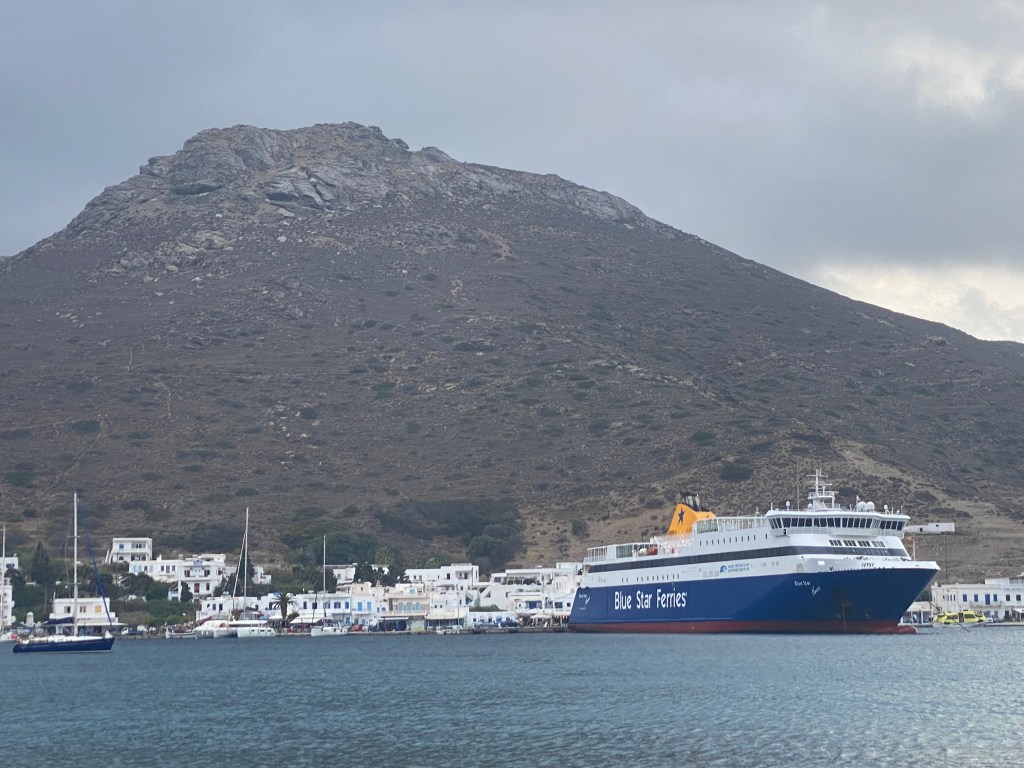
The ferry from Paros stopped at a number of islands, Naxos, Irakleia, Shinoussa, and Koufonissi before we disembarked at the last stop, Katapola on Amorgos. We checked out each island in some effort to decide which one we should go to next. Not an easy decision to be made from the deck of a very large ferry.  Large, luxury yachts and cruisers dotted the serene coves of many of the islands we past. We agreed that maybe Koufonissi should be next. It consists of three islands, one and a half of which is uninhabited and dedicated nature reserves – but that would be after Amorgos.

The ferry was large but not nearly full. There were tourists most of whom alighted at Naxos and then slowly some more at each of the other ports. By the time we were on the last leg of the trip, there was a smattering of tourists and lots of Greek grand mothers, Ya-yas. What is the collective noun for Ya-yas? I suspect it might be a gaggle by the sound they made –  loud talking and laughing all of which accompanied the various groups playing card games. There were about five or six card games happening at close proximity. The talking and laughing convivially went from within each group, out across to other groups. 

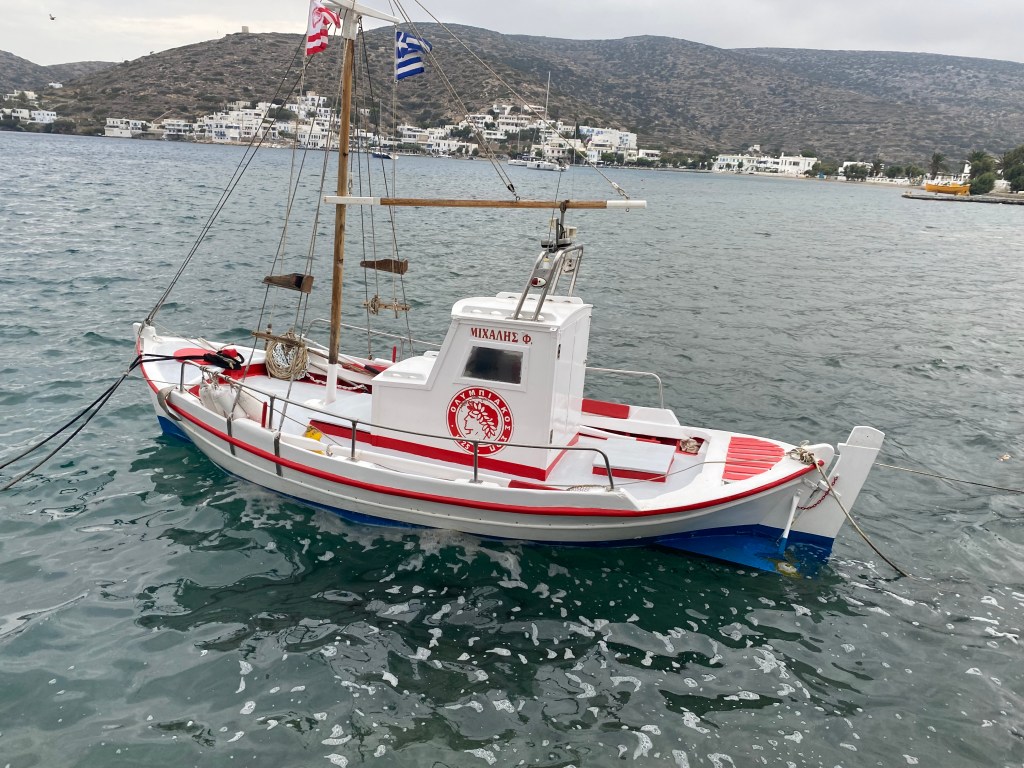
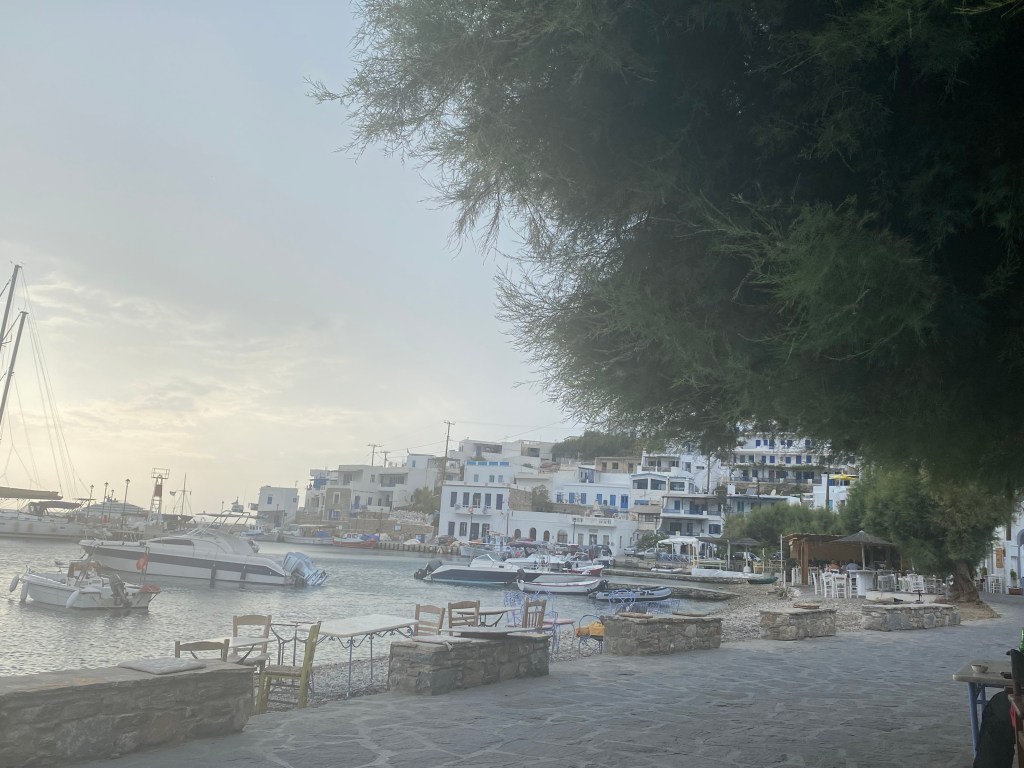
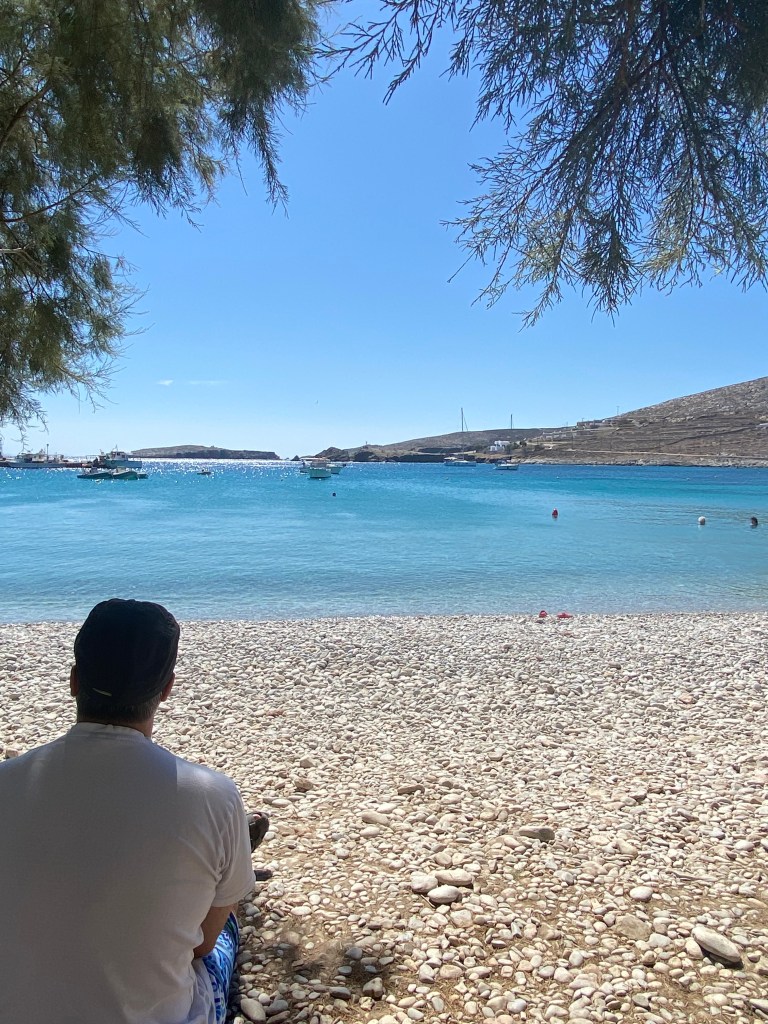
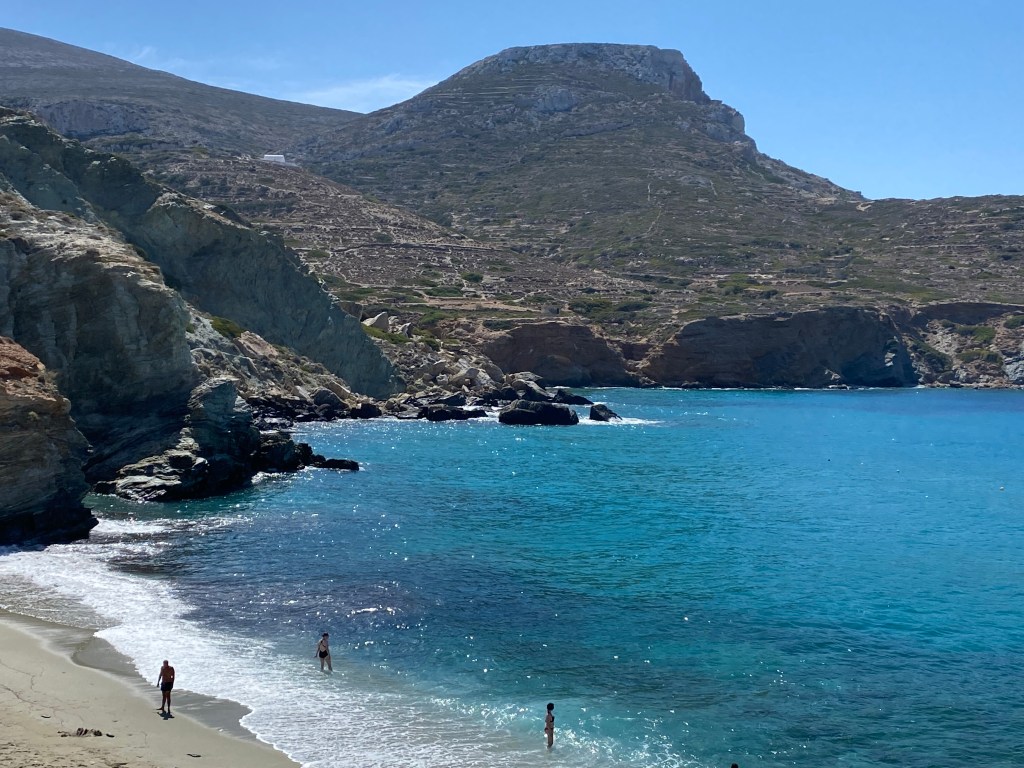
As we entered Katapola, one of the two ports on Amorgos, I smiled. This! This was what I had been dreaming of. The small white-washed town hugged the horse-shoe port. The harbour was calm – yachts, bobbed up and down on the blue Aegean. A smattering of people waited for the ferry to dock and small sandy beaches were speckled with only a few swimmers and sun-bathers. Tavernas lined the narrow path that skirted the port. Surely this is where the Greek Gods lived.

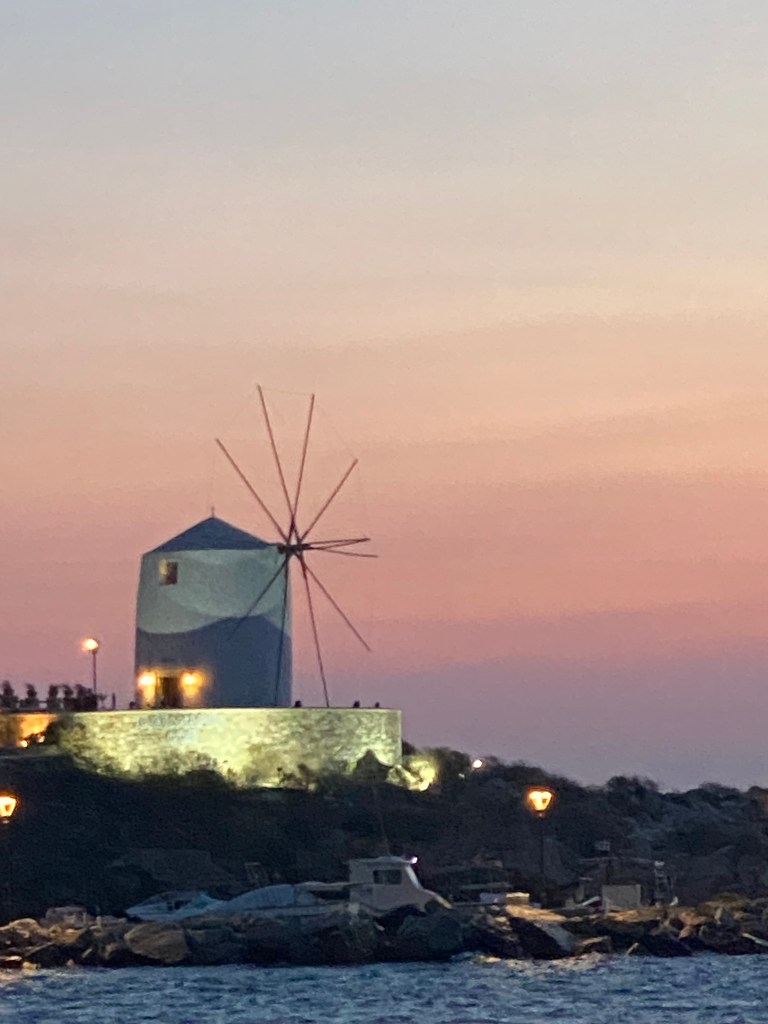
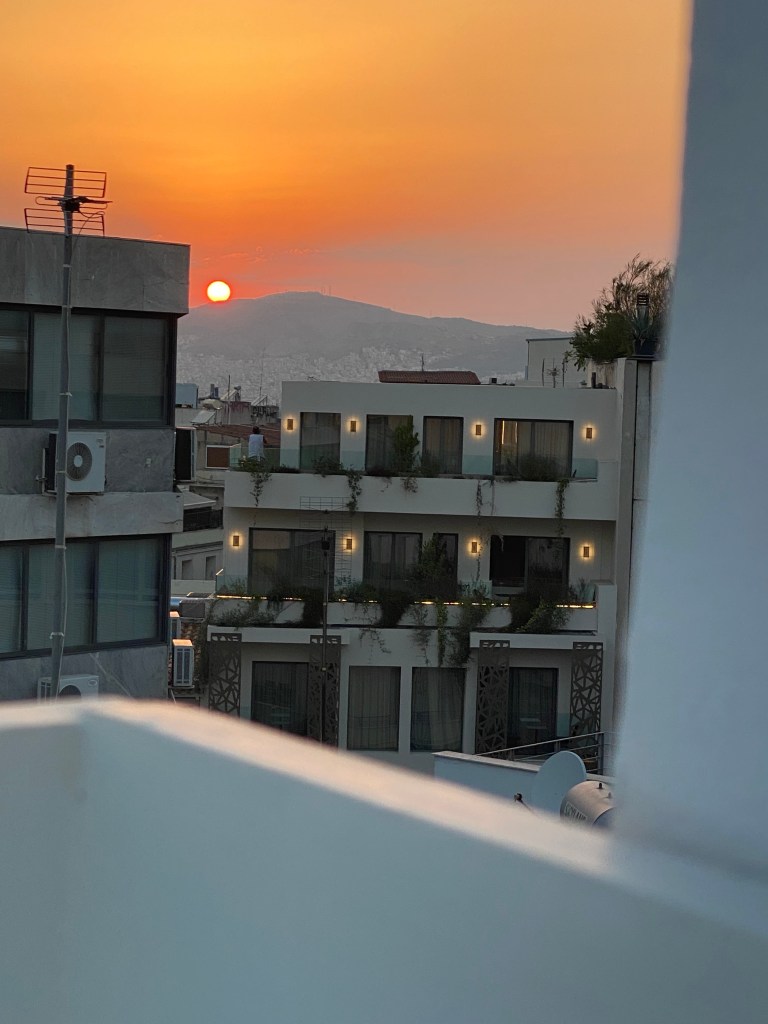
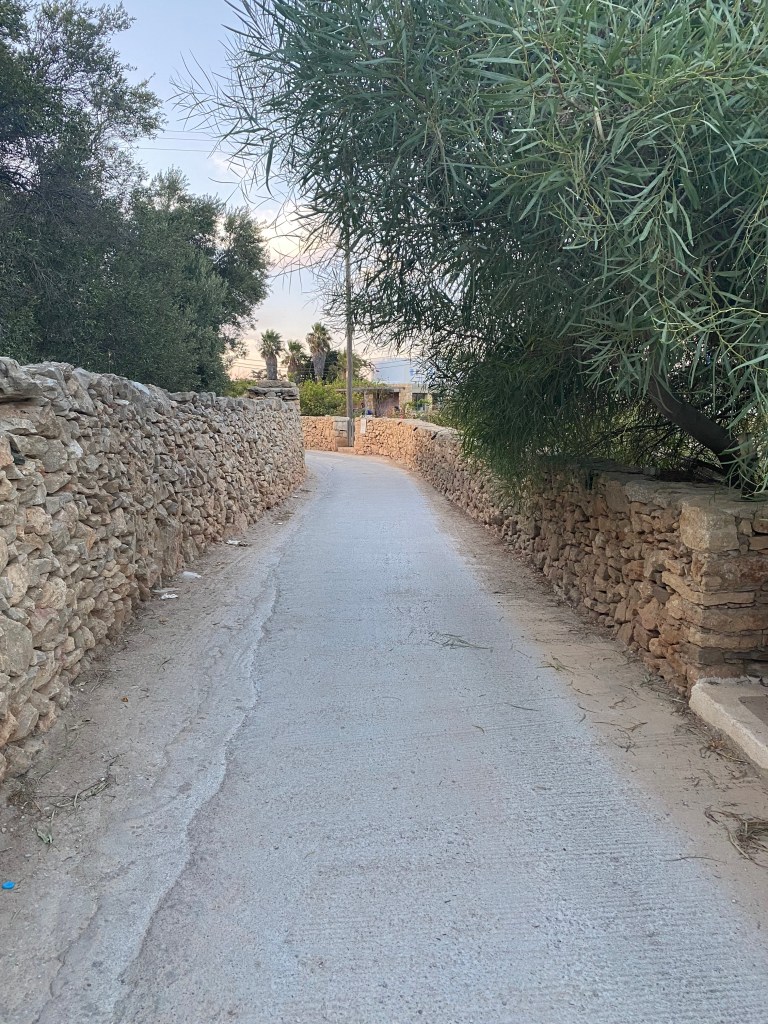
Sophia, our AirBnB host, met us off the ferry, I guess we were fairly easy to spot amongst the Greek women. She walked us around the corner and took up a set of steep stairs to our first floor apartment. It’s clean, it’s compact, it has location, location, location. The little flat is jammed in between the port and a huge mountain – on a narrow alley –  naturally!  Last evening and today have been spent walking along the port, swimming at the beaches and sampling a few of the tavernas. This evening, we watched the sun, a large orange circle, drop behind another island in the distance while it shimmered over the sea before making is slow decent. Tomorrow we are hiring a car to explore the rest of the island. Look out.  Look out! Amorgos is working its magic.

Paros, My Pretty

Paros is very pretty. Well at least the bits I’ve seen are very pretty. 

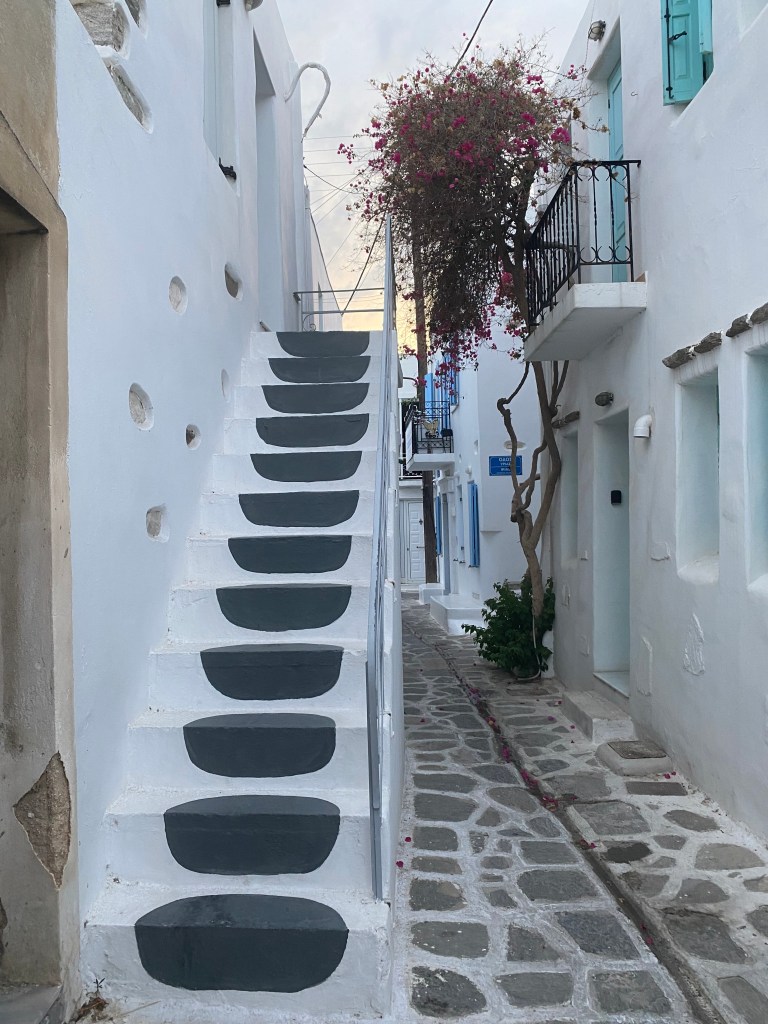
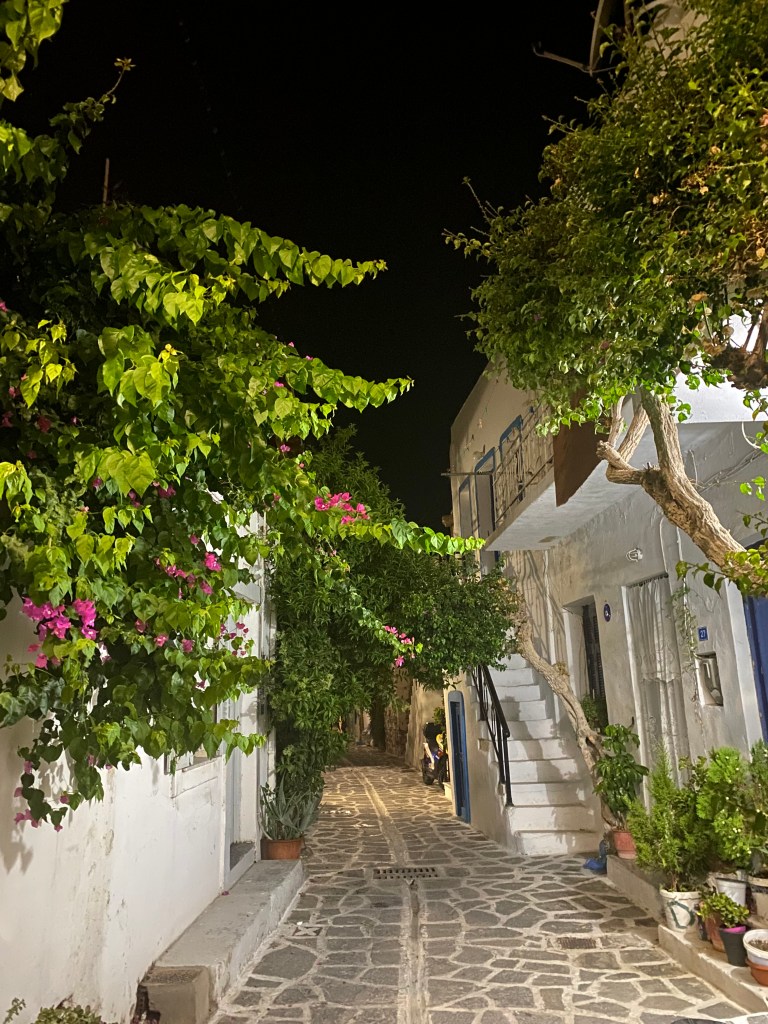
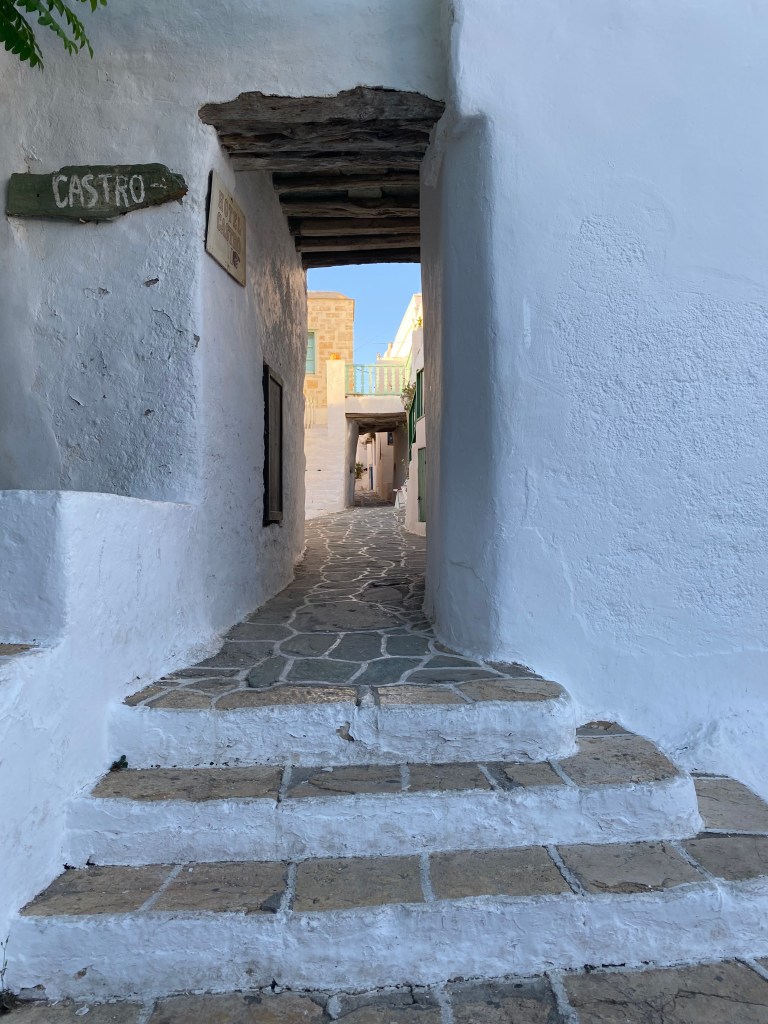
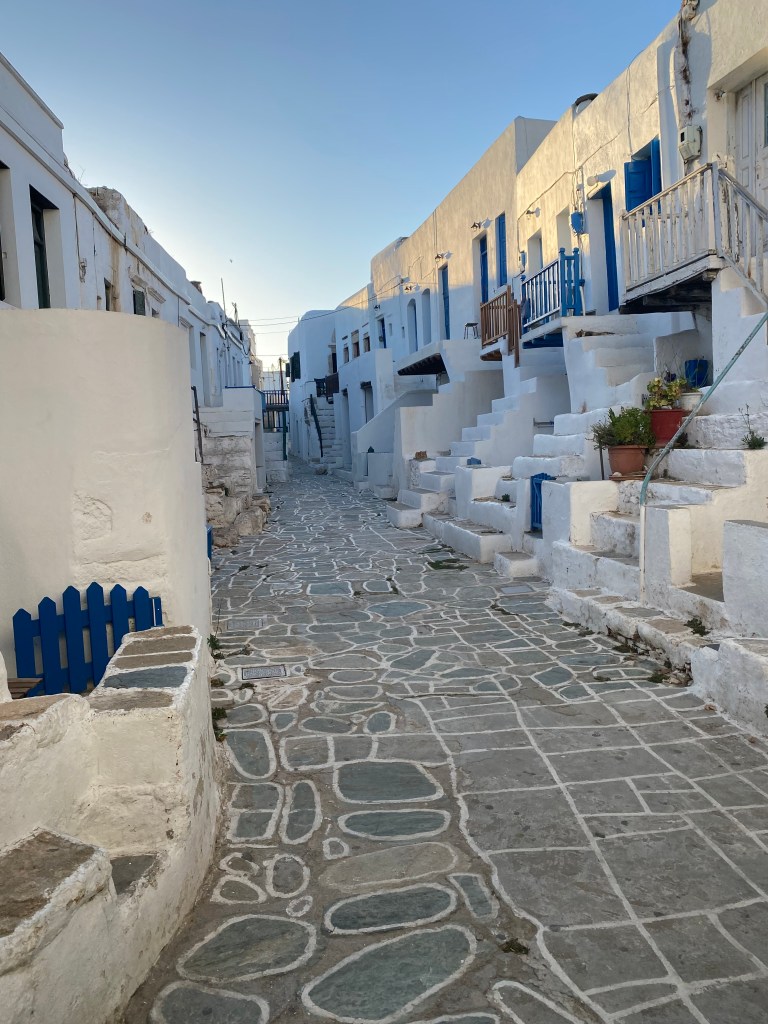
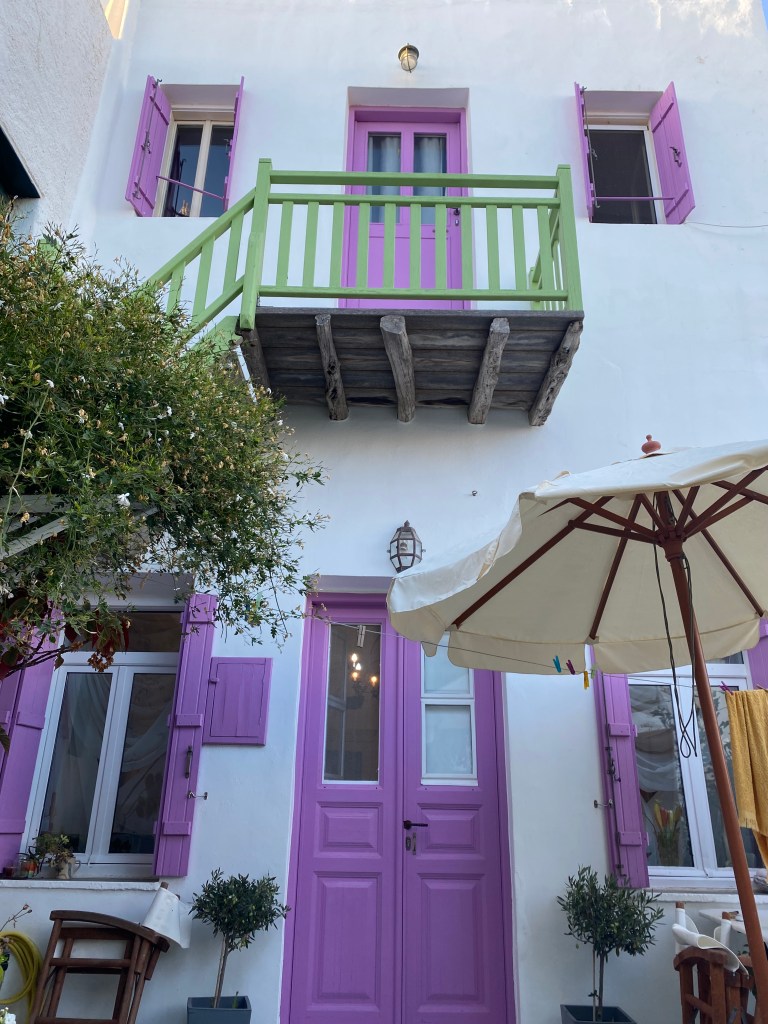
When we disembarked from our fast ferry, we found our way to our accommodation through the narrow alleys and back passage ways of the old town. The first of the passages was dedicated to retail. Fancy clothing shops, boutiques, shoe shops, home wares in the Greek style and the inevitable souvenir shops. As the alleys twisted and turned the boutiques made way for the houses and gardens of the residential area. White box shaped houses with shuttered doors and windows – usually a shade of blue lined our way. Cats slept lazily in the shade of a step or an olive tree, maybe opening one eye, to check us out as we passed by. I was certain we would be lost in the maze, but in no time at all we were at our accommodation, Angeliki’s Studios, just at the edge of the old part of town.

We arrived to be welcomed by a woman who spoke no English holding up a phone with someone’s face at the other end. The young man who belonged to the face, told us the owner would be another hour but we could go to our room. A short conversation then took place between the woman and the young man on the other end of the video call. With that she hung up and disappeared for a few moments. On her return she had a key, two bottles of cold water for us and a tray with three ice-creams. She showed us to our room, indicated the bottles of water were for us, took one of the ice-creams for herself and then left. 

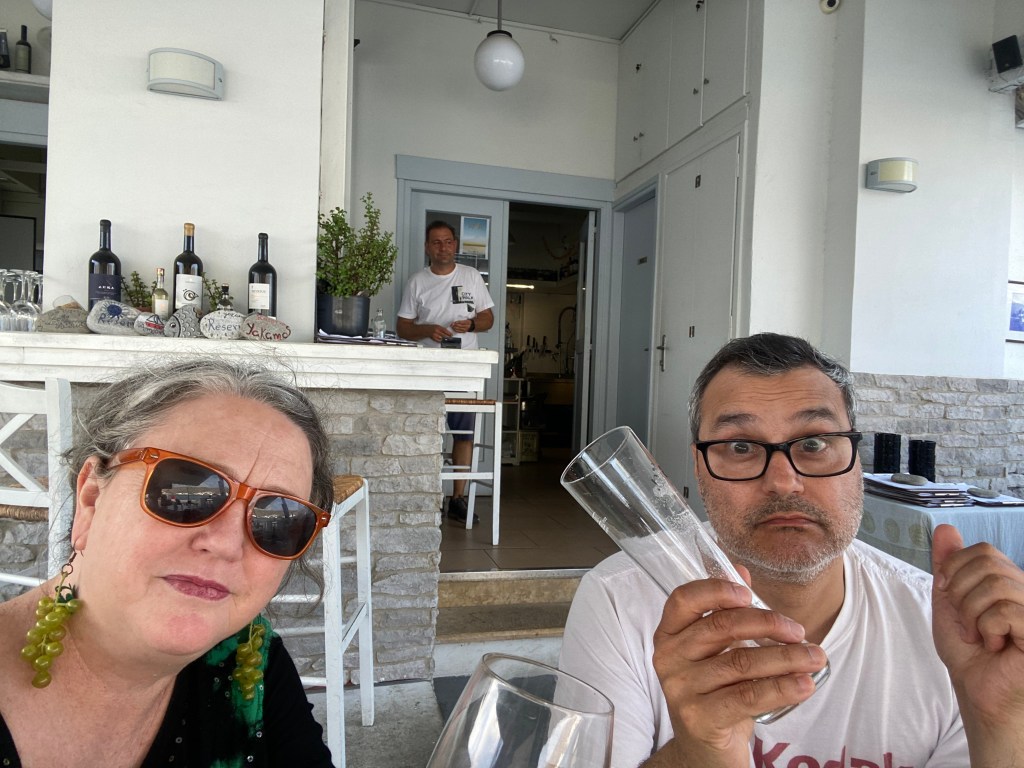
We rested after we finished eating our ice-creams, until it got a bit cooler and then wandered down to the water-front. It was windy and the ocean was all choppy. I didn’t want to end up like a tortoise again, so we would not swim that day. We ate that night at an overpriced taverna by the water. It was the first bad meal we had on the trip. Not bad, just not very good.

While out walking we heard an English girl on the phone complaining to someone how many Australians there were on Paros. She was right. There seems to be lots of us here but I guess that isn’t surprising given the number of tourists on Paros. There are no cruise ships chugging in everyday but Paros is the major hub for the island ferries, so most island hoppers transit though and stay at least one night on Paros.

The following two days were not pleasant. Basically they were spent trudging in the hot sun, waiting in one for buses in the hot sun and bickering. The first day, we caught a bus up to the hill top town of Lefkes. It was pretty but all there was to do was to trudge down the hill in the heat, through pretty white washed houses and tourist shops to look at the church at the bottom. Then to trudge back up again in the heat, through pretty white washed alley ways  and houses with bougainvillea and over-priced tourist shops to the top again. 

The second day we caught the ferry over to the nearby island of Antiparos. Antiparos where the rich and famous have villas – Tom Hanks, Madonna, Matthew McConaughey and others. We didn’t see any of them as we trudged across the island to the beach. When we got to the beach it was windswept and rough – so no swimming again. We trudged our way back again across the island – you know the usual white washed villas, bougainvillea, narrow passage ways, overpriced tourist shops and boutiques. 

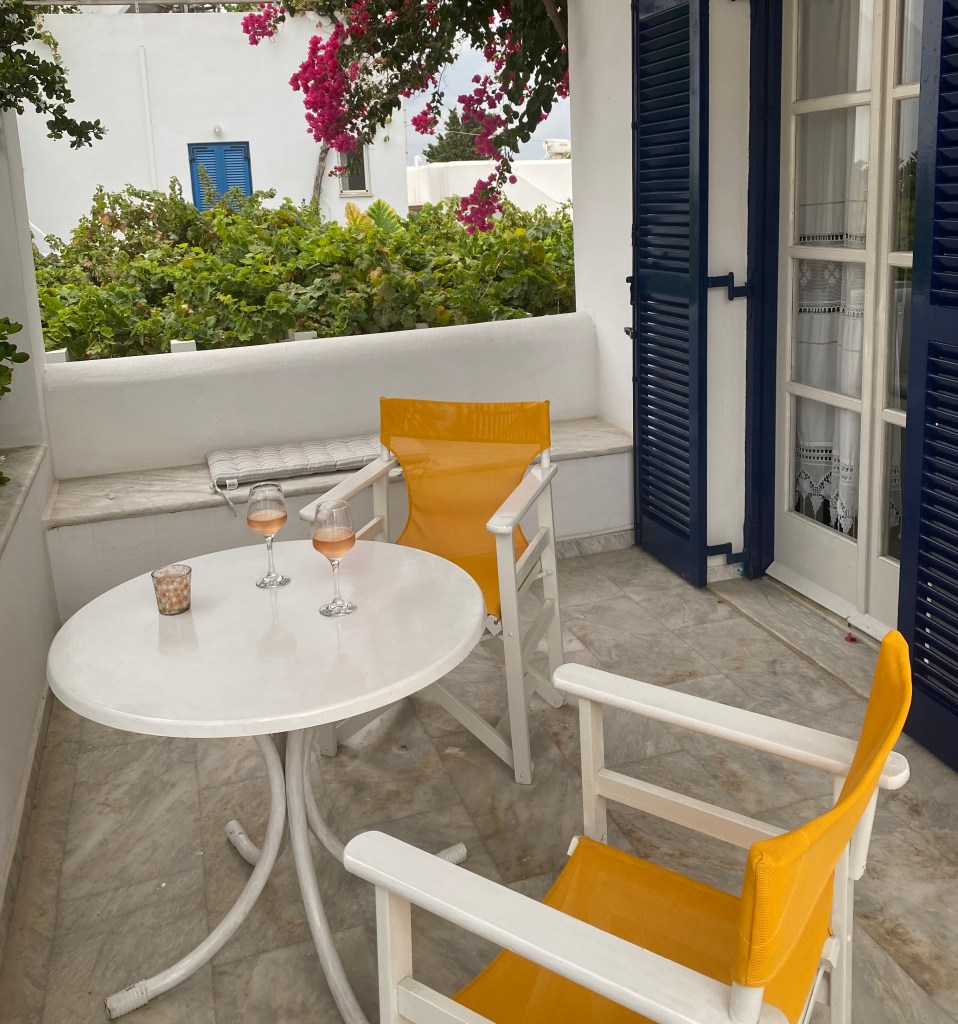
When we were back at our accommodation later that day, the older man who runs Ageliki’s knocked on our door and gave us cake. “My wife”, he said by way of explanation as he passed the cake through the door. We wondered if it was to make up for the jack-hammer that started outside our window at 9:00am that morning or if it was just part of the service. The rooms are amazingly clean and comfortable, and, we have our own large verandah where we sit with a pre-dinner glass of wine at the end of each day.

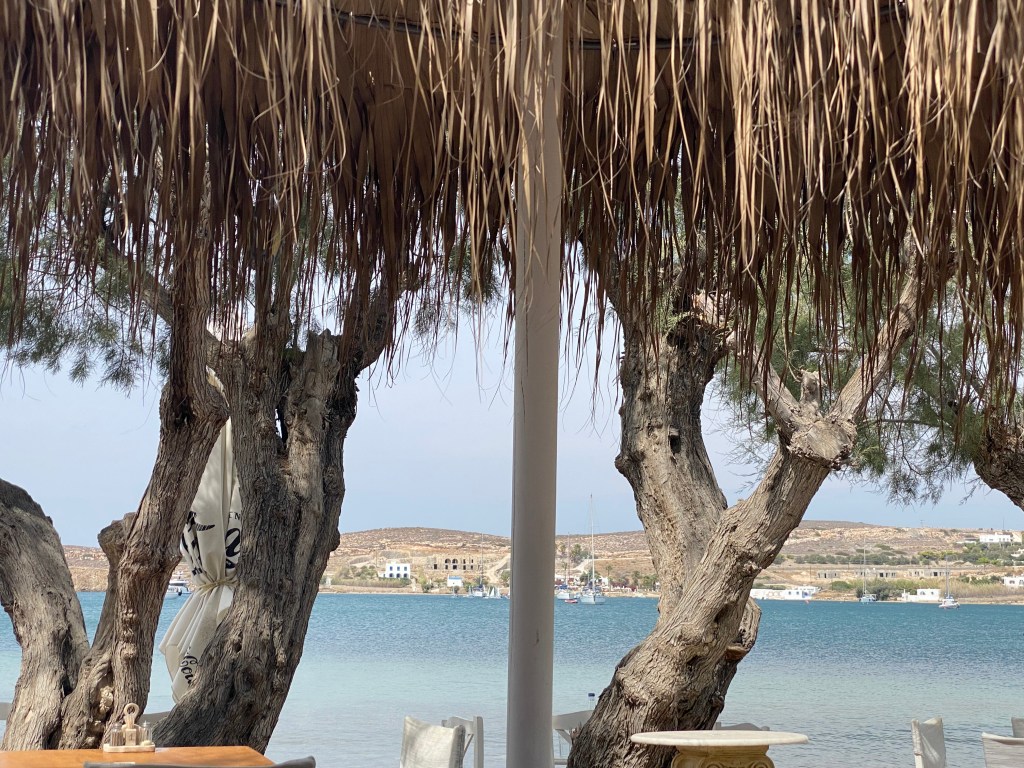
Yesterday, the day began much the same, trudging to the other side of the port. However, there was gold at the end of this rainbow. We found a protected beach. The water was calm and clear. There where trees for shade. There was plenty of room for us to find our own spot. I went in. It was beautiful. We stopped at a little gyro place on the way back that surprisingly wasn’t too expensive and had lunch. For the first time in two days, I was happy again.

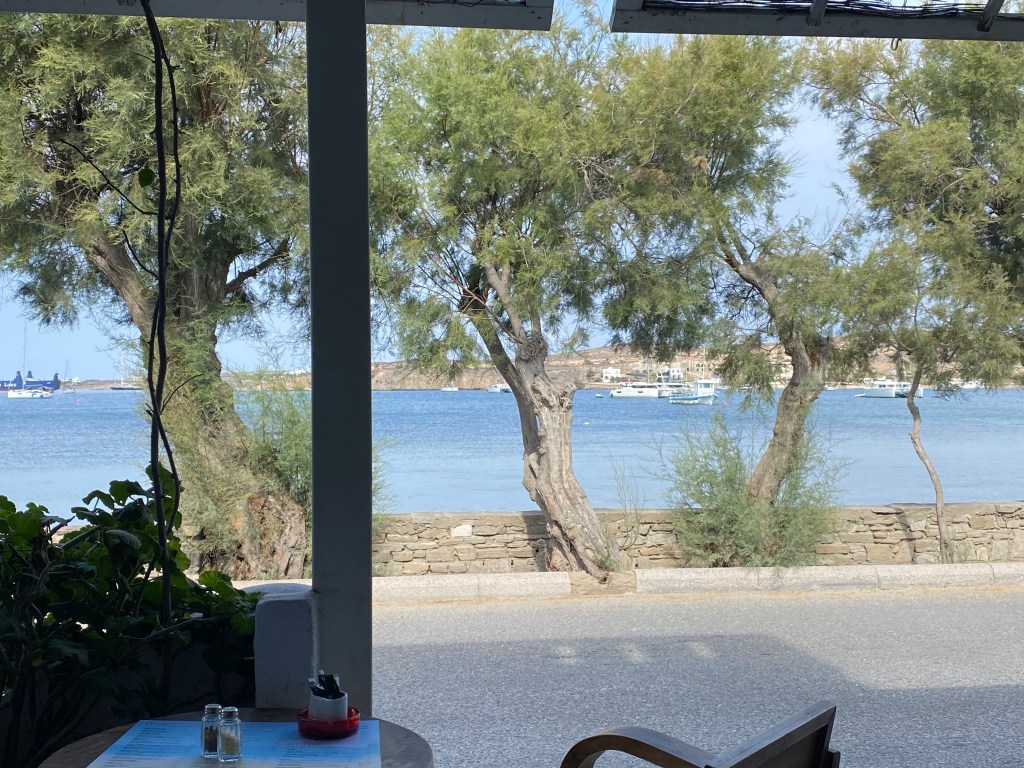
Today was our last day here. We headed to the same beach. Found an excellent place for coffee on the way. Swam and floated in the warm waters and dried out in the shade of a tree. We lunched on shared calamari and cold beers in a shady taverna on the seas edge.  I declared it another perfect day.

Tomorrow we take another slow boat, to the small island of Amorgos. I won’t be sorry to leave Paros. Five days here was probably  a little too long. As I said, it is a pretty place – but it is also, pretty touristy, pretty expensive and pretty bloody windy. 

Fortune Favours the Brave

When we arrived at our hotel in Folegandros and met Theo the owner, he told us how lucky we were to get the room on such little notice. He told us it was only because of a last minute cancellation. A regular guest, an Italian photographer, got a last minute job so he had to cancel. I agreed with Theo that we were taking some chances.

“No matter”, he replied “fortune favours the brave … or is it the foolish?”, he smilingly questioned. 

I smiled back replying “Both”.

We stayed for three nights and two full days on the island. We walked its old streets, ate at wonderful restaurants and wondered why we weren’t staying longer. 

We went to the beach. Two beaches in two days. All the long, cold, bitter south Gippsland winter I have been longing for the sting of sun on my face and salty water on my lips. To feel the weightlessness of salty water. It has been the prize I have kept my eye on as I have worked two jobs, carried wood, lit fires, rugged up and generally been frozen a lot of the time.

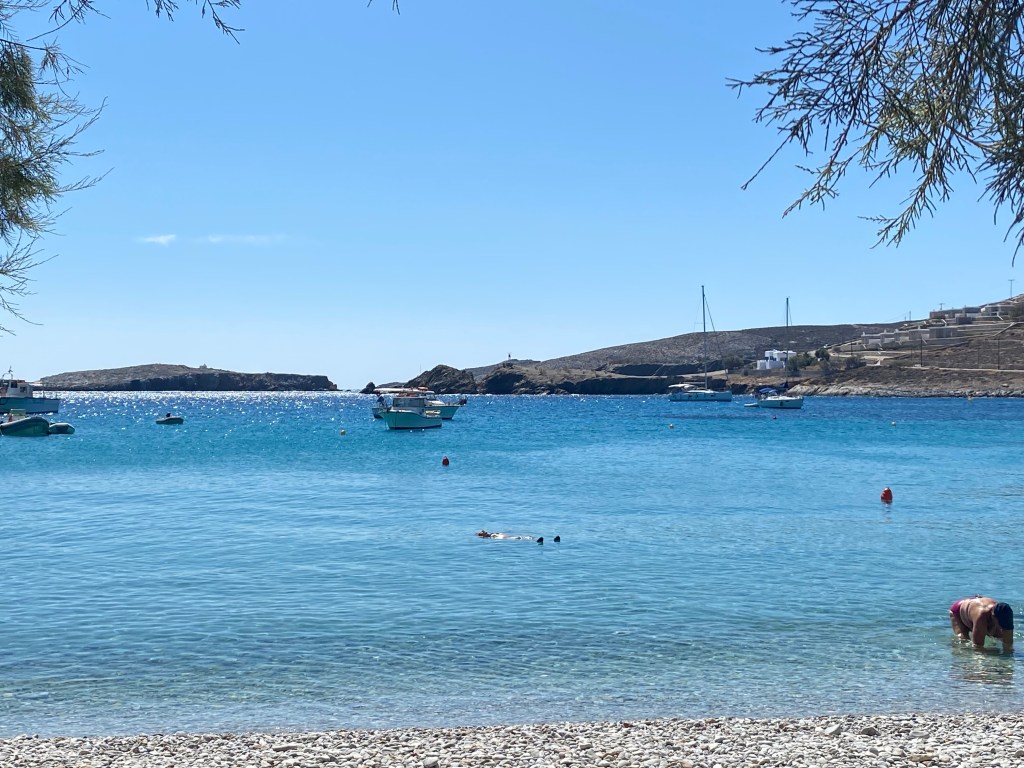
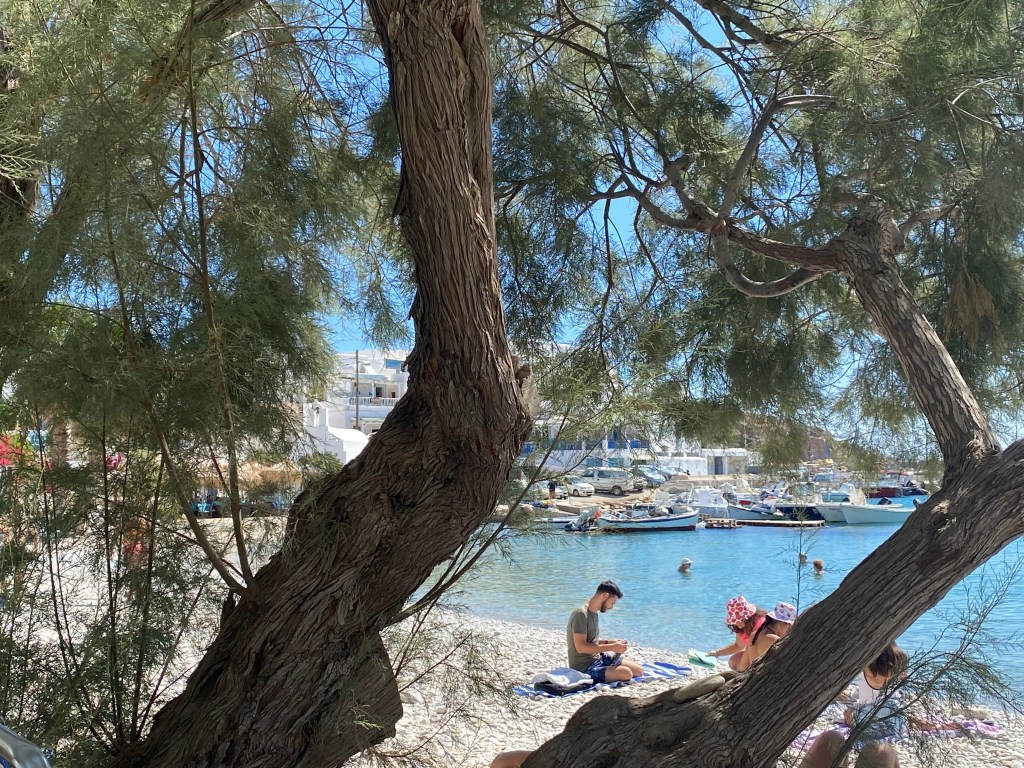
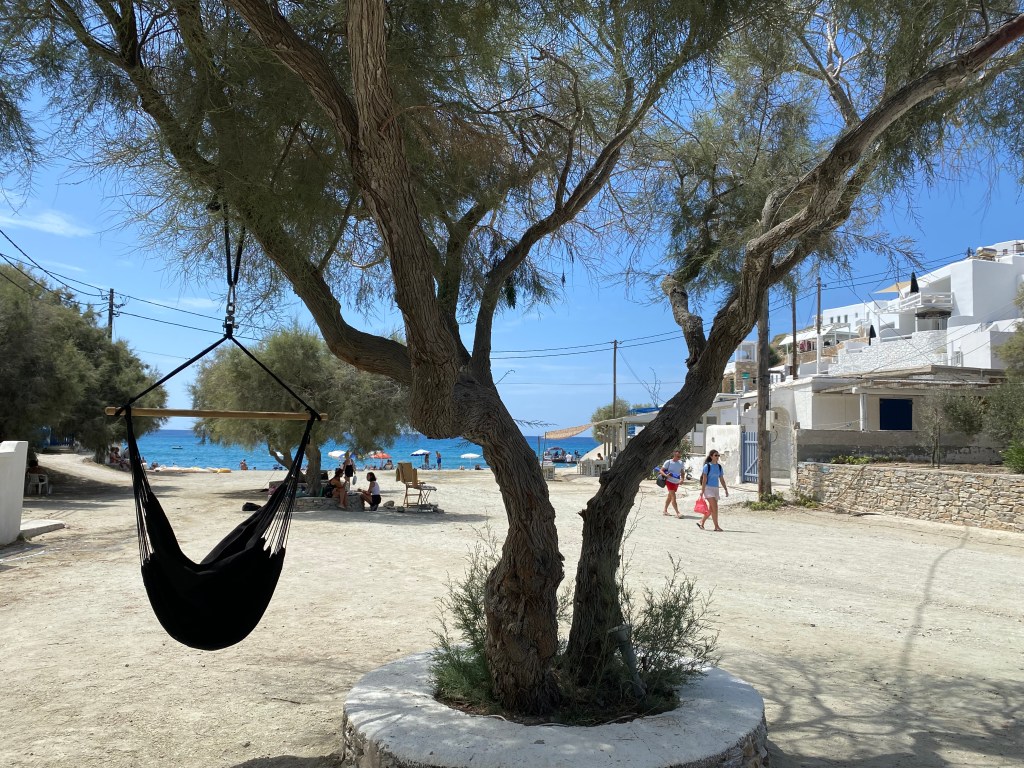
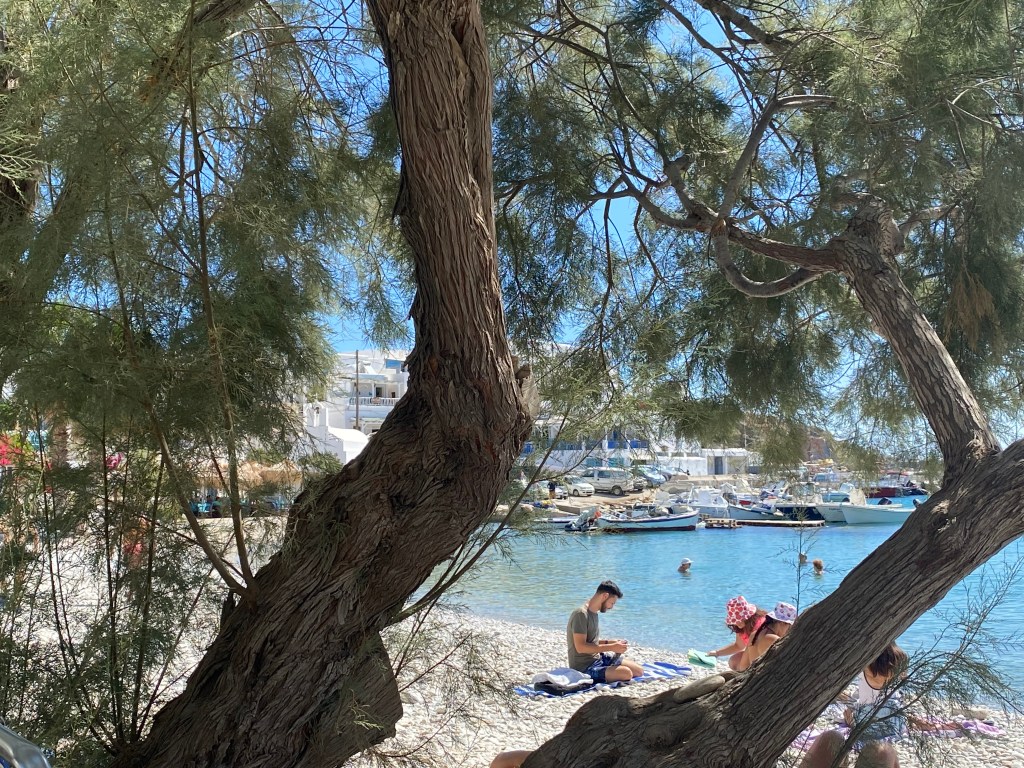
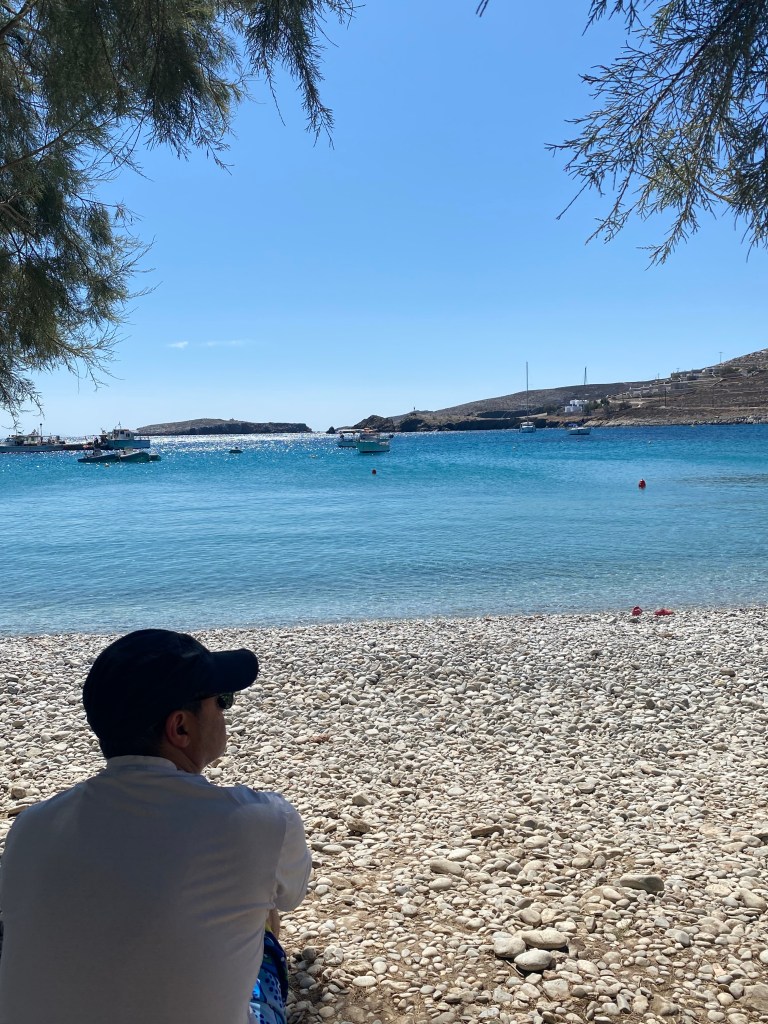
On our first full day we caught the bus down to the beach just near the port. It as the beach we saw when we arrived in Folegandros.  On the beach, we found a shady tree and set up underneath it. The beach had large pebble stones so I chose to wear my sandals into the water after watching Robert ooo-ahhh-ouch dance his way down to the shoreline. The water was cool and crystal clear, we could see fish swimming around our feet. There were no waves, so we just floated until it was time to head to the taverna for calamari and cold beer. 

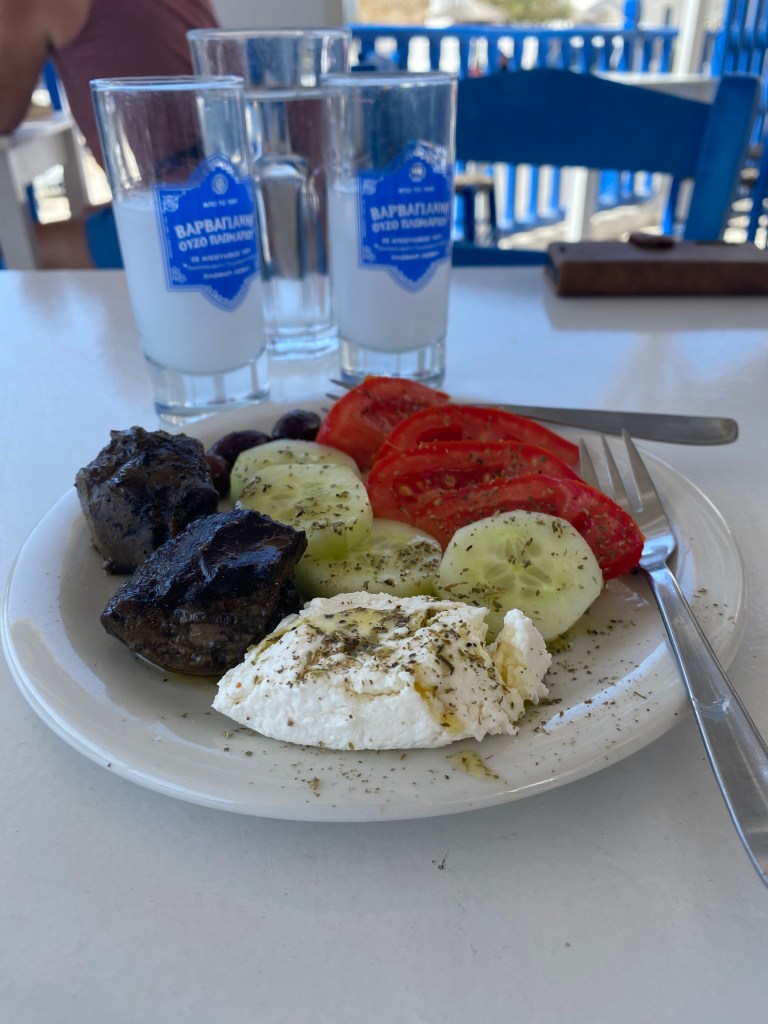
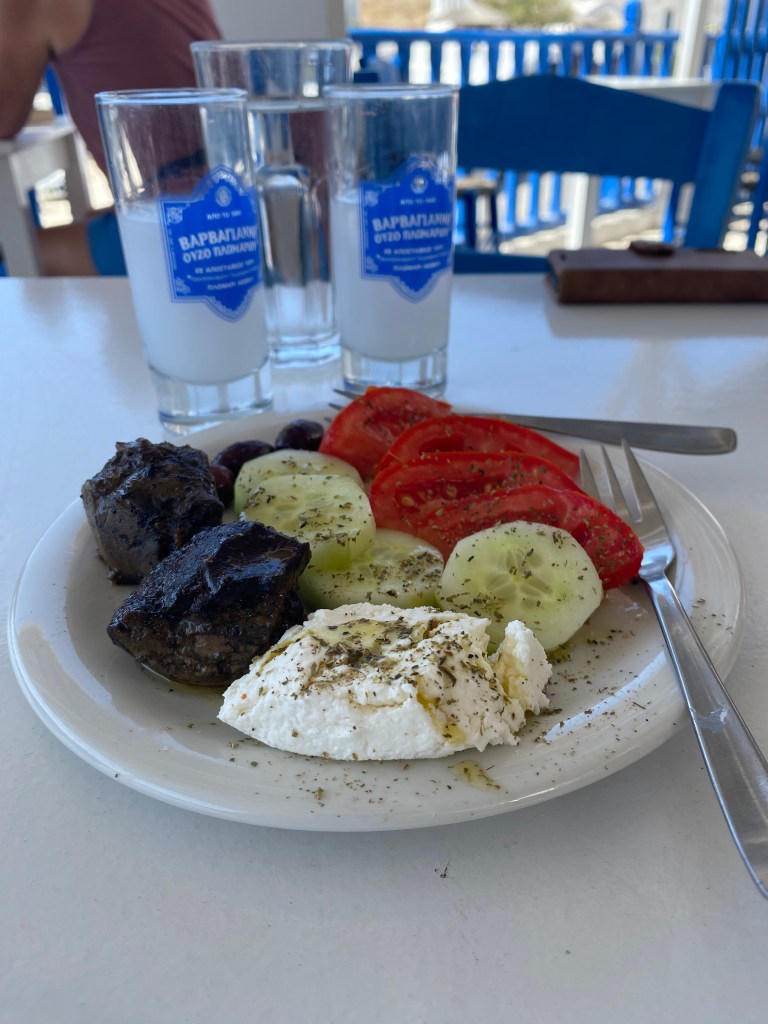
Unfortunately, we just missed the bus back up to the Chora, so we stopped and had an “ouzo with snack”. This was a bonus until I took a bite of something brown that I mistook for a mushroom. It was a kidney. EuuuurrrK! Other than the kidney, it was a perfect holiday day.

That night we spoke to Theo about extending our stay. He sadly told us he didn’t have any rooms to give us and fortune would not favour us this time.

The following morning, we took a bus in the other direction. Theo, had told us there was a fishing village, with a few tavernas and beach – with sand not rocks. He gave us a beach umbrella as he warned us there would be no shade. He also said, there could be waves due to the wind the previous evening and to take care. Robert told him not to worry, we would surf the waves.

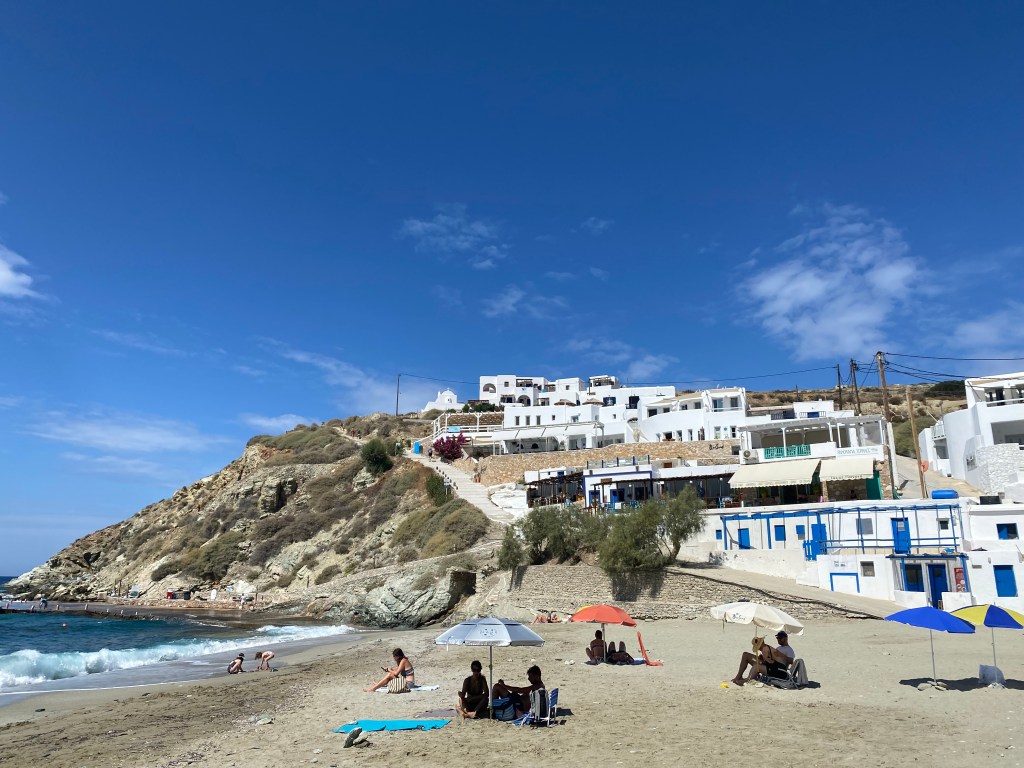
The bus trip to the fisherman’s village, Agkali, was an event itself, the driver speeding down a steep, narrow dirt path. Tourists on scooters and quad bikes fanging up in the other direction made hair pins turns even more hair raising and stomach churning.  At the end of the track we reached the little fishing village. A handful of tavernas lined the path to the beach and houses and resorts dotted the hills behind. The beach wasn’t exactly sand. It was mainly a course sand with small pebbles, about the size of Rice Bubbles. We found a spot, set up the umbrella and looked a the ocean. There were waves. Nothing too big – just medium ones we would body surf at home. In we went. The surf was powerful and it was hard to stand up. Robert went in further than me, I tried walking out to join him. BOOM! A wave hit me and I  went over and under. Suddenly I was flat on my back, legs and arms stretched upwards in water that was only about knee deep.   Like a giant tortoise, I was flailing. Trying to stand but I couldn’t.  The waves kept crashing down on me and over me. All I could do was scream with laughter. Robert tried to help me but I just couldn’t get up. Mainly because I was laughing but by now he couldn’t stop laughing either. I think the crowd on the beach were laughing too. Finally I managed to right myself with Robert’s help. Inside my swimming costume were a million pebbles. It looked like underneath my swimming costume I had a bad skin condition. I thought I looked like a patient on the British TV show, Embarrassing Bodies. It was an uncomfortable ride back home – and we didn’t even enjoy one of the tavernas as we made the decision to just go back to the hotel and swim in the pool.

The next morning it was time to say goodbye to Folegandros.  Theo dropped us down at the ferry. This trip would be a fast ferry to Paros. Theo said he hoped to see us again. “You suit the island”, he told us. I hope we do return to Folegandros one day – let’s see if fortune smiles on us again.

A slow boat to Folegandros

Another early morning start. It seemed so cruel to do it to ourselves, but truth be told, one day and two nights in Athens and then move on, was the only plan we had. Now we had another – a 7:00am ferry to Folegandros. So with that we woke a 4:45am, packed up and made our way down to the metro for a train to Piraeus – the port of Athens. The dark streets were largely empty except for a small smattering of backpackers with similar plans. Oh! … and a guy wearing only undies and sneakers. I’m not sure what his story was, just part of the fabric of Athens, I guess.

We worked our way through the system well and boarded our ferry. It was to take nine hours and stop at Serifos, Sifnos and Milos – all places that had been on our list. Yet, for some reason Folegandros won out.

We had debated whether to take one of the faster ferries. However, the slow boat won out. The reasons:- 

* It was cheaper

* there was more outside space to enjoy

* stopping at other islands would give us the opportunity to see them and decide if we wanted to go there

* the mode of travel seemed less aggressive than the wave pounding jet boats.

It was a good decision.

The trip was smooth and uneventful. We shared our time between outside at the front of the boat and some inside seats. At each island, we made sure we were outside. We also ran out to look if we chugged past any other islands – and there were quite a few of those. I was struck by the colour of the Agean Sea. Never have I seen a blue like it and trying to describe it, would be a waste of time but it was a magnificent blue.

The ferry was not crowded and most people were Greeks. It felt good not to be part of the international tourist crowd – whom we assumed were all on the jet boats. People got on and off at the stops. I had thought the logical thing would be the ferry would empty more as we moved along the islands. Not so, in Milos a crowd of young, international, bikini wearing tourists boarded the boat. We felt overrun. Not only that, where were they all off to? Folegandros. It has a population of just 800 people, surely all of these tourists couldn’t be going there too? Panic set in – we still hadn’t booked any accommodation. We quickly had find something by using a combination of guidebooks and apps and make a booking at Ampelos, in the Chora – or main town.  We chose it as, like a good bottle of Australian wine, it is the second least expensive. 

Then we did the next sensible thing and checked where the ferry was off to – not an easy tasks as the ferry sites are quite specific and you need to know what you want. Talking it through, we worked out it was probably headed for Santorini after Folegandros. We checked the site, yep! Ios and Santorini – but Robert and I are less worried now we have accommodation booked.

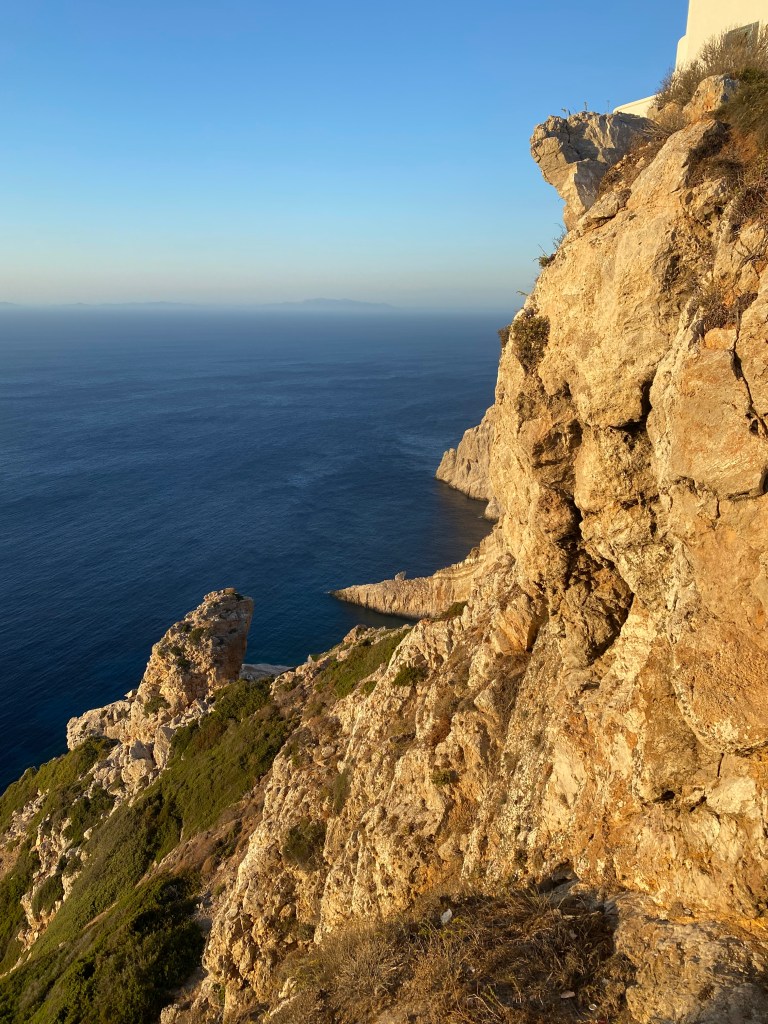
As the ferry begins its glide next to Folegandros, we are in awe the huge, rugged cliffs that stretch from the sea straight up to the sky. Apparently it was used as a place of exile for political prisoners from Roman times to as late as the Greek military dictatorship of the late 1960s to early 1970s.

When we arrive at the port, only around 30-40 people disembark. Next to the port is a pretty beach, with people sitting in the shade of the trees. It appears there is no “beach commerce” chairs and umbrellas for hourly hire here. The owner of our accommodation, Theo, is there to greet us at the dock and takes us to the hotel. It is like walking into an oasis. A sparkling pool sits in the centre of colourful villas covered in a riot of grapevines and different different coloured bougainvilleas. Our little bedroom villa has two outdoor areas either side to allow us to chase the shade throughout the day if we decide to stay at home. Through our typical little blue Greek window, we can see down to the sea and other islands. 

We have two guide books. One describes the island as having “verdant countryside” the other describes it as “bleak and arid”. It is probably somewhere between both. Certainly our hotel sits on the verdant side of the argument and the view looks out across arid to the blue sea and other distant islands – but Folegandros is not bleak. It is beautiful. We find out how beautiful later that evening when we walk into town for dinner. 

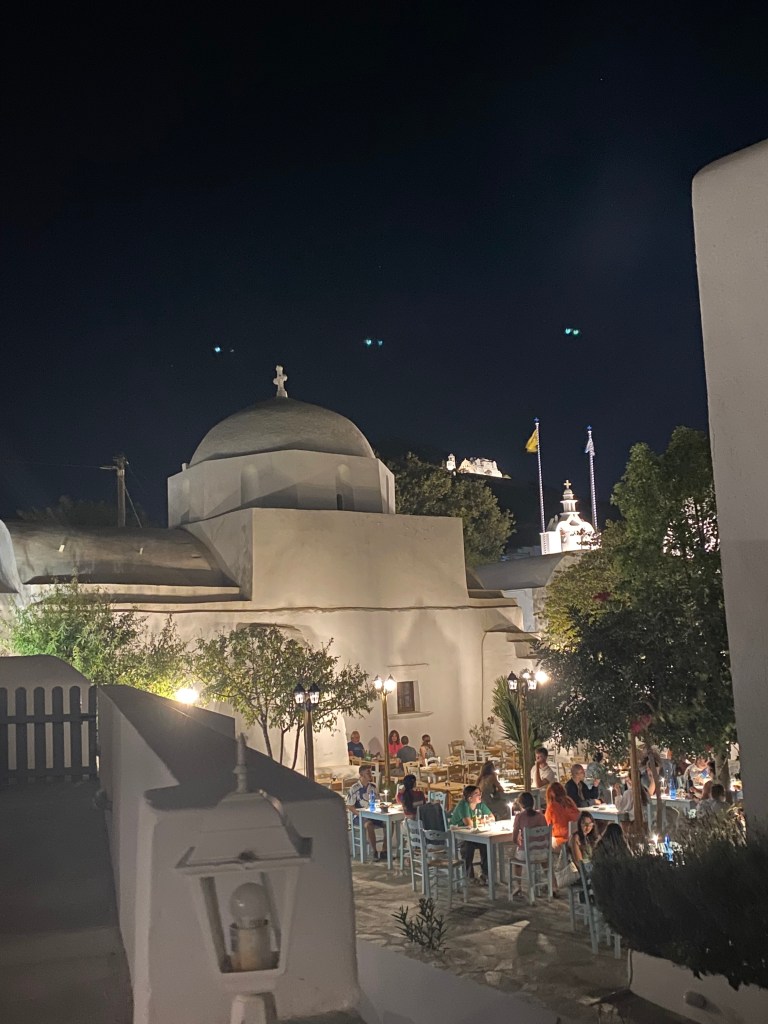
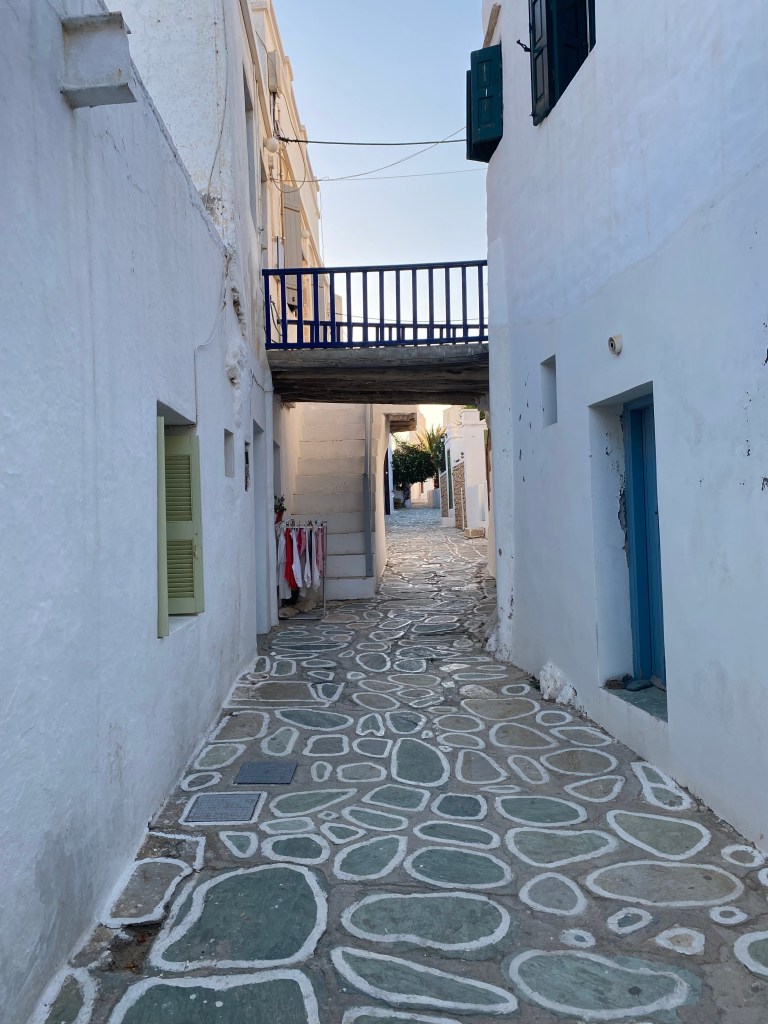
This is where the photos take over. You’ve heard of places being “instgrammable” – this place is the nirvana of scenic vistas, five plazas are linked with classic narrow winding laneways and small white houses. There are many churches and cats lounging on every drystone fence, sleeping in every spot of shade, eyeing off every person that walks past the step they sit on. The food is pretty amazing too. 

My last word on Folegandros is – get here before the Kardashians and those of their ilk. Get here before the cruise ships. Get here before beach commerce hits. Get here before there are no more slow boats.

I heart Athens

Long haul flights are hell. Any one who has ever suffered through a long haul in economy knows this. Through this hell, two things happened of note. The temperature when we landed in Dubai was 44 degrees. Even in the terminal, we felt the searing desert heat.  The second thing of note, happened on our flight from Dubai to Athens. We were just thirty minutes from Athens when the head flight attendant approached our seat and asked “Ms Slattery”? I nodded in reply as a thousand thoughts ran through my head on why he had searched me out. Rapidly he introduced himself, shaking my hand and asking “How is your flight today, is everything OK”? I nodded and he was gone. 

Robert and I looked at each other. 

“What was that about?”, he asked.

“I have no idea”, I replied.

With that we began our descent into Athens.

Given the long haul hell and the level of tired we both were. We quickly ditched our plans to work out the subway to get into the city and find our hostel. Instead we opted to get a taxi. We breezed through immigration and, surprisingly, customs was not existent. This allowed us to be on the taxi queue within 30 minutes of landing. The queue seemed long but moved quickly. Even better, there was a slight breeze which cooled down the heat we had been inhabiting our bodies since Dubai. 

To us, the taxi rank seemed chaotic but it worked beautifully. We jumped in our cab after a short wait. Our cab was very clean and our driver, Vasilis, welcomed us to Greece. He showed us two routes on his iPad and asked if we wanted to go the longer, less expensive route at 40 Euro or the faster one for 45Euro. We chose the faster one. 

He flipped on some traditional Greek music as we raced down highways and through tunnels towards the city. It had gotten dark since we landed, so that it was impossible to see too much of the outskirts of Athens. Once we got closer to the centre, Vasilis started to give us a tour, pointing out important buildings, sculptures and places. He gave advice on the area we were staying, including some restaurants we should try. Vasilis asked if we were going to the islands and mentioned Folegandros, among others. Before much longer, he dropped us outside our hostel, bid us a happy vacation and left. He was a great introduction to Athens.

We checked in, showered, and when straight to bed. Not giving much thought to the complimentary earplugs left next to the bed.

Our bed was comfortable, our sleep deep. Waking up early the next morning, we headed straight out to have a look around. Our plan was to stay in Athens for two nights, just long enough to recover from any jet lag and to get a feel for the city before our return to Athens at the end of the trip. We walked through the market, strolled around ruins, found the metro for when we needed to head to the port the next morning. We were still talking about the different islands we could go to next and working out what times ferries left. We had no plans. Nothing booked. We were enjoying Athens.

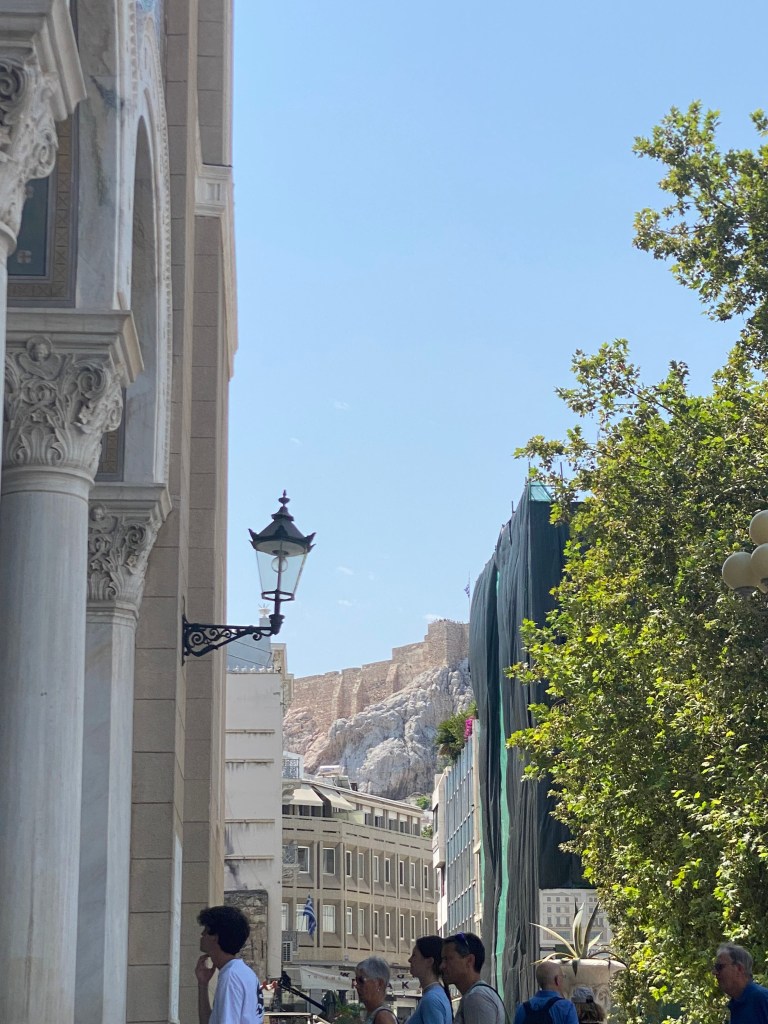
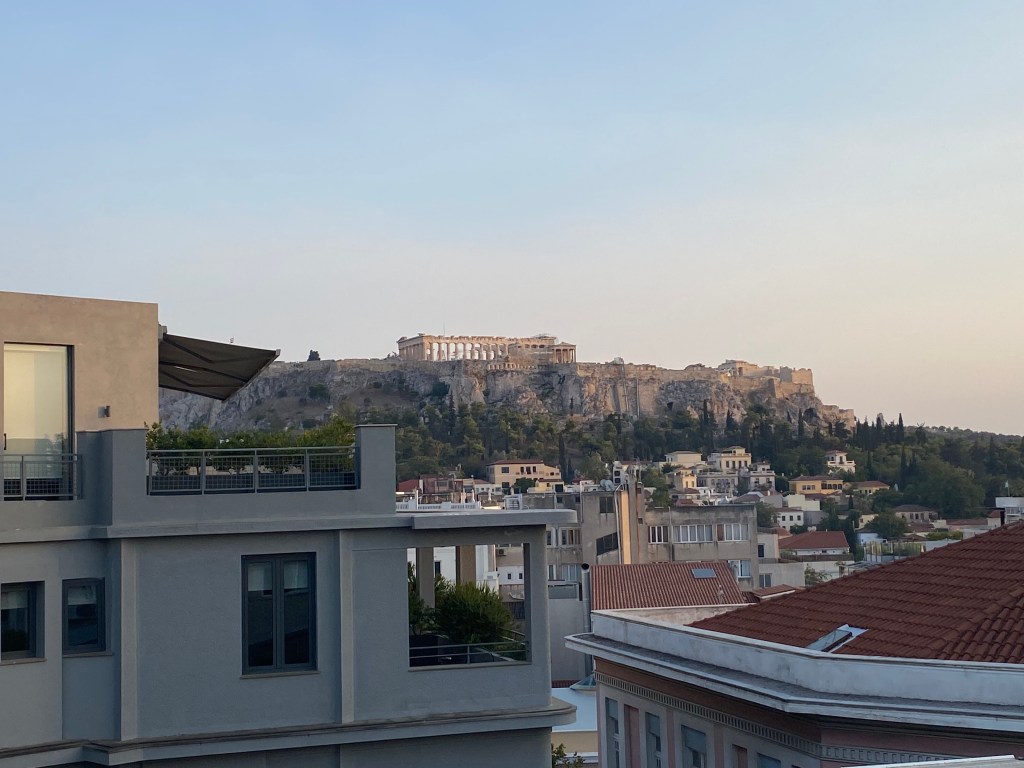
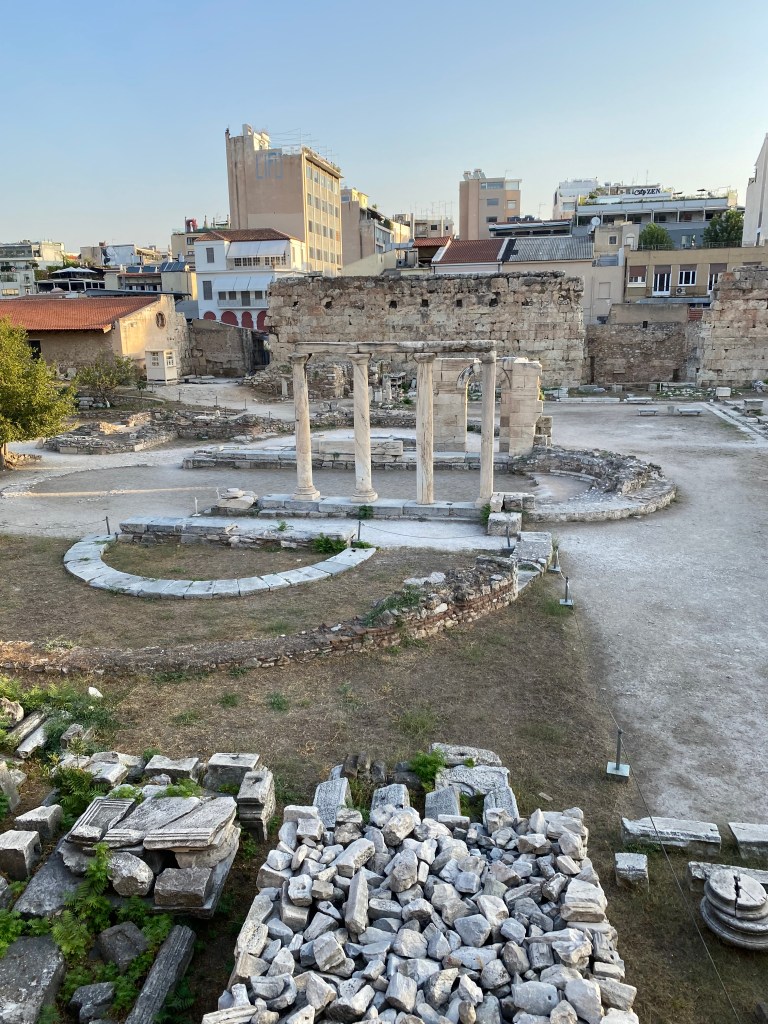
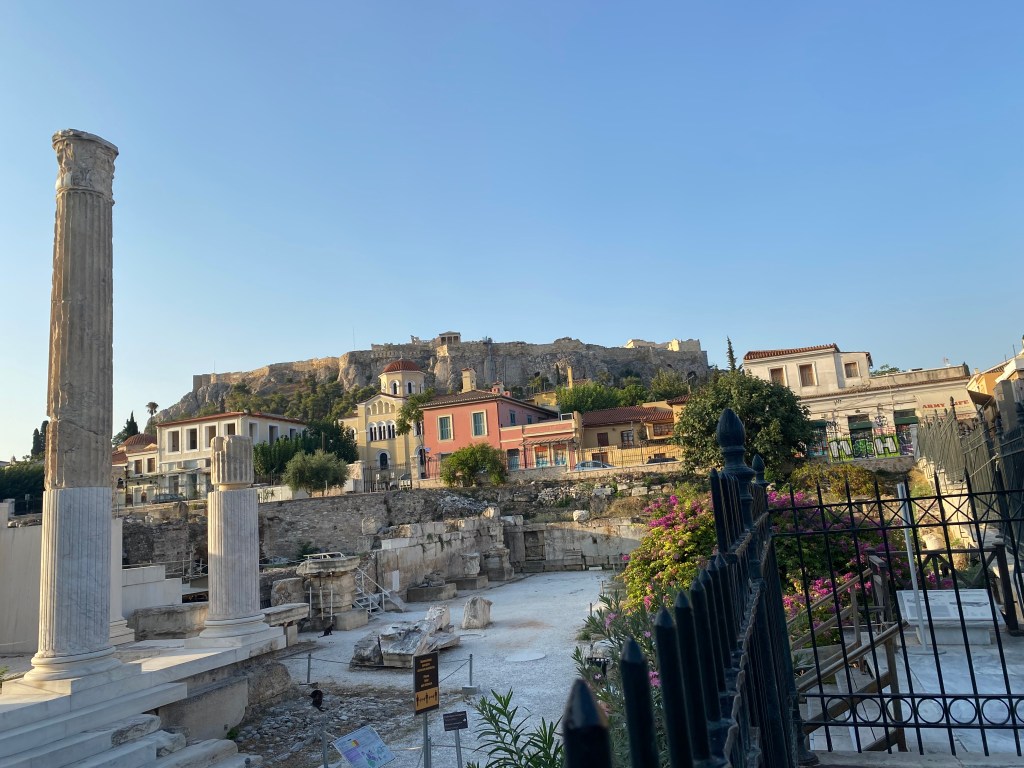
Later that evening, at sunset, we sat at the rooftop bar of our hostel, drinking a margarita each and looking up at the Acropolis. We agreed we both like what we knew of Athens so far. Good food, dive bars, ruins and cold beers. Athens has a run down feel, like it is tired, but its energy just won’t give up. It’s ancient heart beats strong and its people carry each other along as it always has. 

We talked about our plans for the following day. it was decided. A slow boat – nine hours – to Folegandros. What we would find there, we did not know.

Greece is the word

Way back in 1987, I went to Europe for the first time. The guide book for the trip was a used, and slightly out-of-date, copy of Europe on $20 a day. I went with a friend to England, Spain, Paris, Venice. In case you hadn’t guessed by now, we had a limited budget, a couple of backpacks, friends and relatives to stay with and the hope of visiting the Greek Islands and Turkey. When I’ve told people that I’m heading off to Greece, many ask the question “Have you been there before?”. My answer … well …. I was once on my way there, but I was detained in Bulgaria.

While staying with family in Paris, train tickets were bought from a travel agent to Istanbul. The plan was to take the train, get off and spend a few days in Venice, get down to Istanbul and have a look around and then make our way back to Paris via Greece and the Greek Islands. I don’t remember how much it cost, but the cost would have met the $20 a day budget. The trip would take several days and a number of train changes – usually when we entered a new country. The French train took us to from Paris to Genoa where we swapped to an Italian train to take us to Venice. After a few days in Venice, we got a (then) Yugoslavian train that took us to Belgrade. From there it was another train – by then I had given up on which country owned the train – that was to take us to Istanbul. The travel agent explained all the changes – in French – slightly helpful. What the travel agent in Paris did not explain – which would have been helpful – was that the train would travel through Bulgaria and we would need a transit visa. I don’t even know if I knew of the existence of Bulgaria back then. It was part of the Soviet Union, an eastern bloc state behind the “Iron Curtain”.

As the train was making it way through the night, I started chatting to a young Scottish girl who shared the compartment. On asking if we had transit visas for Bulgaria and explaining they were necessary, panic set in. A quick look in the guidebook confirmed this was the case and the no-one got through without a visa. Before being able to comprehend what was happening the train stoped. Fear set in. We sat there, weighing up the options. What to do? Look like we are young, innocent and dumb and hope they let us through? The young and dumb would not be difficult. Offer to pay for a visa (bribe)? Explain and hope the communists would be good to us? Armed, uniformed soldiers swept through the carriage checking passports. It was our turn. We smiled and started to talk. The man took both passports and ordered us off the train.

As the train left the platform to continue its journey to Istanbul, six people remained behind, the two of us Australians, two men from Syria and two Japanese people, one male, one female travelling separately. Two soldiers ordered us into the station waiting room. The Japanese woman stuck close to me being the only two females.  She had a bag almost larger than her. It was a hard suit case with two wheels on one end and a wrist strap that lifted the other end so that it could be wheeled along.  The bag had stickers all over it of cats, and in big words “I LOVE CATS”. She battled to drag it along into the waiting room. The room was large waiting room on the opposite side to the entrance door was a ticket window. There were long, hard, timber benches down the full lenghth of the other two walls.  The soldiers indicated for us to sit down, as they walked around the room, they stopped in front of everyone individually. Slowly they looked at each of our faces and examined them against our passports, looked at our faces again. When they had finished this process, they abruptly left with our passports, slamming the door shut behind them.

 The Japanese girl, who intoduced herself as Noriko, asked me “Will they check our bags”.

“I’m not sure”, I replied, “why?”

“I have porno in my bag” was her direct answer.

Apparently prior to going to Europe Noriko had been in Australia and stayed in Kings Cross. She told me she was 27 years old and that she had run away from home as she didn’t get on with her father. We chatted for a while until suddenly, all the lights in the room were turned off. Darkness enveloped us all.

Now what?

The Syrians sat together, chatting in Arabic. They were both young men not much older than us at the time. One spoke some English, the other none. In the darkness, I could make out one standing up as he did, he spoke to all of us.

“We go,” he said. “We go to Syria.  All of us.  Syria is good. Bulgaria very bad.”

The Japanese guy turned on a torch and flashed it around at all of frightened faces. In unison, the rest of us were shaking our heads. No, we’re not going.

The Syrian said something we didn’t understand, went over to the door, jiggled the handle, gave it a hefty pull and it spring opened. With that he went into the night.

We all looked at each other and held our breath, waiting to hear a gun shot ring out through our now open prison door. There was nothing. After a while, as nobody seemed to know what else to do, the other Syrian, walked to the door and closed it against the night. By the torchlight,the rest of us started to use whatever we had to make beds for ourselves on the hard benches and wonder what was to happen to us. Would the soldiers return? Would the lights come back on? I know I didn’t sleep much that night and I doubted whether any of my companions did either.

Before daylight the next day, the door opened again. Locals started coming into the waiting room. Bulgarians on their way to whatever they had planned for the day. None of them gave us a second look as they lined up at the ticket window, which after a while shot up and tickets were sold. People were walking in and out without acknowledging we were there. In retropect, I guess it was a sight they were used to. We weren’t sure what to do so packed up our belongings, sat and wated for whetever was next. We couldn’t go anywhere, we didn’t know where we were, we didn’t have our passports.

One soldier from the night before returned. He looks at us, noticing the missing man.  He asks us where he is. Funny thing is, I cannot remember if he spoke English or another language and we just understood.  In reply, we all shook our heads and shrugged our shoulders, in the hope we weren’t to be interrogated or implicated.

The soldier indicated we were to follow him. He took us across to the opposite platform just as a train was arriving. A test of skill and dexterity for Noriko to get her bag across the train tracks. One-by-one, we boarded the train. One-by-one the soldier handed our passports back to us. We sat with the two Japanese people. As the train started the journey back to Belgrade, Noriko said to me “OK breakfast now” and from her large suitcase, she pulled out three oranges and two cans of beer. We drank the warm beer thankful to be leaving Bulgaria.

Both the Japanese decided to get to Greece another way together. My friend and I decided it had all been too much and after a short stay in Belgrade would head back to England.

Sometime after returning to Australia Noriko sent me a postcard from Mykanos. She told me she loved the Greek Islands, that it was a very beautiful and special place. Noriko also wrote that the guy “was not a nice person” and had tried to hit on her, so she had run away from him on a ferry somewhere.

At the end of the postcard, in Russian Noriko had written “Калотина”. She had also written it in English “Kalotina – the town which we were stayed”.

I kept that postcard stuck on my fridge for many, many years along with an ache to one day make it to Greece.

The time has come.
Fear of finishing

Paris welcomed me back with open arms. It was cold and wet, and the bus I was on terminated a stop or two earlier than expected, but I enjoyed walking through its streets again. It was just on dusk and the rain made the streets all clean and shiny as the light from the street lights bounced and reflected on the footpaths and cobblestones. As I turned into Cité Bergère, I felt at home. A man walking towards me smiled, nodded and said hello before I could return the greeting he started to apologise saying in English “I thought you were someone that I knew”. I laughed and touched his arm saying, “you do know me Phillip – Genevieve”. We both laughed at his mistake. Phillip is a friend of both Jackie and my friend Cate. I met Phillip when I lived in Paris earlier this year. After chatting for a few moments I made my way further down the narrow street to Jackie’s. Madame Bouchard, a neighbour of Jackie’s walked past said her greetings and spoke to me in French. I nodded and smiled with no real idea of what she was saying, but the general understanding that she was pleased to see me again and that Jackie will be happy to have me back. They all know that I am Jackie’s sister.

I spent almost two weeks in Paris. It was cold and it was wet most of the time. I didn’t visit any of the sights or the galleries. I walked a lot around the areas I knew well. Walked across and along the river. Walked to the left bank a few times. I walked more aimlessly than ever before. Looking back now, I know I was suffering from the fear of finishing.
Christmas was two days in Normandy in the dual towns of Trouville-Deauville. These beautiful towns are separated by a river – which when I was there looked more like an empty storm-water canal. Deauville is flashier, high-end, its sister Trouville is much more Bohemian in its look and feel. At Christmas with fairy lights and decorations glimmering and glinting on the streets, both towns made me feel I was living in a fairy tale. It didn’t snow but it was cold. Christmas Day was spent with Jackie, Cate and Phillip eating seafood. If it hadn’t been so cold it could have felt like an Australian Christmas.

After leaving Normandy I returned to Paris for a few days before beginning the journey home. I spent two of my last three days in Paris in bed feeling tired and ill. From my bedroom at the front of Cate’s apartment in the 9th, I could hear Paris wafting up at me from the Rue de Hauteville below. I could hear Parisians taking as they walked past three floors below. I could hear the angry beeping of horns as someone blocked the street which would often turn into yelling or and ensuing argument. One time, I heard a woman sobbing as she passed. I felt for her and wondered what could make her so sad as to sob so loudly as she walked down the street. As I lay in my sick bed, willing myself to feel better before having to begin the journey home, I soaked up the sounds of Paris, hoping never to forget them and hoping to hear them again.

Jackie met me at Cate’s on the morning of my departure to walk me to the Gare du Nord to catch the Eurostar to London. I would spend one night in London with an old school friend before boarding my flight to Melbourne. Jackie was in a bad mood – maybe it was because I was leaving, maybe it was because she was over-tired, maybe it was because she thought she was coming down with the same bug I had and was irritable that I had ‘given’ it to her. Whatever the reason, it made for a funny walk to the station. Jackie cranky is still witty but woe betide anyone that deigns to think they can speak to her. By the time we had reached the station she had told-off a handful of people in both English and French. It was only as we were about to enter the station I looked up and said to her “Jackie, this is Gare de l’est not Gare du Nord”. A few minutes of expletives started our short walk to the right station. When we got there it was absolute chaos. Long, long lines of confused people, harried staff, arguing couples, children crying. I looked at Jackie and told her to go. In her mood, it wasn’t a good place for those near us to be.

Finally, I get on my train which is now looking like being an hour late. The journey is uneventful, as I watch the French country side speed past. I look out at Calais, before we enter the tunnel to travel under the English Channel. I see the fences, high fences, that end in spikes and barbed wires. These fences are to stop refugees risking their lives, as they attempt to use the tunnel as a means to enter Britain. It is a sad sight to see. In London, my old school friend is waiting for me at the station. I haven’t seen Eraina in almost 30 years. Not surprising I am a little nervous about how much time has changed us both and if we would still get-on like 17 year old best friends. There was no need for nerves. With true friends, time always stands still. Despite the grey heads of hair, despite having our own teenagers (possibly the cause of our grey hairs), despite the difference in the lives we have led, it is like we are still teenagers at school. We laugh at things we remember, we talk about the other girls, we do a bit of facebook stalking to see what some of them are up to. We remember and remind each other of a time before we began the journey that would become our lives. Eraina’s husband and children are wonderful too yet before I know it Eraina and her daughter are driving me to the airport for my flight and I am wishing I had stayed longer.

Now I am back in Sydney almost a year to the day since I left. It has taken me a while to finish this final installment. I started, I stopped. I wrote and I deleted. I opened my computer and closed it again. I just could not seem to find the motivation to write. I moaned about writer’s block to my friends in Victoria. Finally, someone said three words to me that really was the problem. Fear of finishing. Now I have finished. My gap year is over and I must go back to the real world.  The real world does not consist of living out of a suit-case, or walking 800 kilometres for the sake of it. The real world does not consist of walking up the side of volcanoes or accidentally stumbling into nudist villages. The real world consists of a steady job and the straight and narrow path of a middle-aged woman setting herself up for comfort in old age. After all …. who needs adventure?

The beginning of the end

As I prepared to do just as Nina did, leave Madrid for Paris to begin the journey home, I reflected on our journey together. Sure, I took a slight detour or two, Estapona and Lanzarote – but our paths merged for one last time that final night in Madrid. Prior to leaving Madrid, Nina spoke to the maid, Rosita, about all the places she missed out on visiting. I too am thinking about places I missed out on seeing but more importantly, I am reflecting about all the places I have been. Not just in following Nina’s footsteps on this trip but my whole gap year. I was preparing to return to Paris – back to where it all began.

I took my last paseo (walk) from my hostel, up and through the Puerta del Sol towards the Plaza Mayor. I looked around me as I wandered through Sol. The usual buskers, beggars, touts and lottery ticket sellers were there. I remembered Nina’s description of her paseo. She wrote:-

“All the street-sellers are out, and all the beggars. Shabby and dusty, the necktie vendor moves hither and thither offering to the strolling crowd a score or so of silk ties flung loose across his arm. The cake-seller stands against the wall, an uncovered basket at his feet from which passers-by who have no fear of germs may purchase sugared buns or fine little pipes of bread or sponge-cakes smeared with jam and then rolled in coconut. The peanut man, the lottery-ticket man, the cool drinks man, the newsboys are all aboard for the paseo shouting their wares.”

The beggars and the lottery-ticket sellers remain but newsboys and peanut man are long gone, as are the tie-sellers and cake-sellers. Now the street-sellers offer trinkets from north Africa and children’s toys. There are mini trumpets that the children in prams blow loudly as their parents push them through the crowds. There are plastic things that light up brightly when propelled into the air by elastic bands. They don’t last long – after three to four trips up in the air the elastic gives and the children cry. Another plastic gadget changes the sound of a voice when it is spoken through. There are glasses and ears and headbands that light up in flouro-colours. African women walk through the crowds in traditional dress with baskets on their heads. Make eye-contact and the baskets are whipped off to show the wares, hand made leather wrist-straps, elephant and camel key rings, fruit baskets that fold into a bread board shaped like an apple. The statue buskers stand still hoping for a few coins to be thrown to them. Others dress up and charge one or two euros for a photo with them. Sol’s Christmas light and decorations shine brightly and the Christmas tree stands tall and shines brightly in its ever-changing colours. People stop to take their photos in front of the tree – and while all of this is happening, the Madrid crowd surges past at its own pace with its own sound.

I looked around Sol before seeing more of the same in the Plaza Mayor. I moved with apprehension. Not because of the Madrid nightlife or its people but I knew the following morning I would leave for Paris. Paris – the beginning of the end. It is the beginning of my trip home. It is the beginning of resuming a normal life at home. This time, home will not be to pick up a few months work in a different city. This time home is back to Sydney. To live, to work, to once again be with family and friends. The apprehension stems from the knowledge that I will have to find work and to start life over again. My optimistic self is telling me it will be ok. The pessimist inside is rolling her eyes and sighing heavily. There is the nine-to-five to get used to again. The crowded public transport, the traffic, the people – yet before all of this, there will be Paris. I reminded myself about Christmas in Paris before one night in London and home on New Year’s Eve. It seems to appropriate to sleep the last night of 2017 in Australia and wake up and begin a new life again in 2018 on its very first day.

When Nina spoke with Rosita before leaving for Paris they listed off places Nina should visit in the future. Reflecting on where I have been, I thought I would make some lists.

Top seven places I visited during 2017 that I had never visited before

  • Seville
  • Granada
  • Lanzarote
  • Sicily
  • Dresden
  • Burgos
  • Naples

Top seven experiences

  • Walking the Camino – this will be number one for life
  • Climbing Mt Etna
  • Boating around the feet of Malta
  • Spending quality time with friends in Melbourne and Victoria
  • Meeting the Italian relatives in Molochio
  • Feeling like a Parisian
  • Driving around Lanzarote (don’t mention the guard rail!)

Worst seven experiences

  • Gibraltar – what a let down.
  • Taxi strike in Madrid
  • Hitting that guard rail with my little red car in Lanzarote
  • Avoiding all the cyclists that train in Lanzarote. I was pleased I avoided them it was just an added anxiety getting past them safely
  • My last dinner in Madrid
  • Loneliness that crept up on me at unexpected times.
  • My break-down on the Camino when the pain got too much

Places to visit or re-visit

  • Sicily
  • Seville
  • Lanzarote
  • The rest of the Canary Islands
  • Bilbao
  • San Sebastián
  • Granada

I guess that means I’ll be travelling to Spain again some day. Preferably not alone.

Expect the unexpected – it may be worth it

I am driving on the right-hand side! It is exciting. After getting some confidence up, I decided it was time to go over to the other side of the island to the Timanfaya National Park. Actually, my confidence isn’t that great yet, so instead of going along the highways, I decide to take the nice quiet country roads. I expect that they will be a lot more quiet and a lot easier for me to drive. For the first time, I go up the hill in front of my place. Well, it isn’t quite a hill – more of a mountain really. It is a two-way road but it also isn’t much of a road – more like a goat track that clings precariously to the side of the mountain as it winds its way ever upwards. I am a cold sweat. I am trying to stick to the right hand side of the road, but the mountain face drops straight down. I am hoping nothing comes in the other direction and am unsure which approach I dread more. To meet another vehicle on the straights where I don’t want to get any closer to the edge or on the dreaded hairpin turns. There aren’t even any trees to hit and maybe stop you, if you do go over the edge. Just straight down. I am slowly crawling along, even if I wanted to turn back, I can’t. There is nowhere to turn so I just have to keep going up. After what seems like forever I am up the top and with a great deal of chance, I didn’t see another car. There is a view point, so I get out for some respite, breathing heavily as the wind chills me even more cold due to the cold sweat. The view is amazing and when I see the road I had just driven up, I can’t help but swear loudly.

Not far from the view the goat track meets, what the map calls, a main road. The road base is better, and slighter wider but now the hairpin turns come through cut-outs in the rock. You cannot see if anyone is coming in the other direction or not. Also because it is a main road there are more cars. I am too anxious to head completely over the other side of the island and decide to return by another route and visit the Cactus Gardens instead. The gardens were great, again designed by Cesar Manrique, the signs on the both the men’s and ladies toilets were fairly impressive as were all the cactus plants. After this,  I decided a coffee was in order and headed for the nearest town on the coast.

Driving into the little town, Charco del Palo, there is a large billboard. On it are a naked man and women, holding hands looking back over their shoulders and smiling at those who enter the village. “HA!”, I snort, I have found the nudist beach. I have a short stroll around town to check out what looks like the best place for a coffee. I pass one, it looks a little boring. I see a sign for another café that proclaims it has a tropical garden. Thinking that sounds nice and relaxing after the drive, I head towards that one. It’s closed but there is a sign out the front promoting their “naturists dinner nights”. I laugh, so the nudists come up from the beach to dinner. I head back to the boring one and get my coffee fix. Inside I notice a sign while paying my bill. It is printed out from a computer. There is a naked man and woman but they have clothes over the top of them. In Spanish the words say “no nudity here”. By now the penny has dropped and I realise the whole town is a nudist town. I just chose the clothing only café. On leaving town, I came to a stop sign. Stopped the car, looked right, looked left – where a group of naked men are walking along the street – swinging in the breeze. This time my “HA” was extra loud, as I wondered how long I could stop there for before they spotted me. I drove on. That was a sight I had not expected to see.

I finally did make it over to the Timafaya National Park the next day. The line of cars to get in was horrific. It took me an hour from just outside the entrance until I got to the parking lot. The bring the visitor cars in by sections. They will let about 10-12 cars in and get them to stop. When 10-12 cars leave, the waiting cars get to move up to the next waiting stop and so on. This takes forever. Finally I am there but I don’t see what I am looking for. The landscapes are surreal but I was looking for the black circles that make the ground look like a moon or a giant black golf ball. In the gift shop I buy a post card that bears the image of what I am looking for. On the way out I ask the man, whose job it is to get the geyser to blow by pouring water into it, where I can see what is on my postcard. He gives me directions and I am off. Not far away is the sight I have wanted to see. It’s different from what I imagined, probably because I am at street level and the images I have seen before are all from a bird’s eye view. Rather than a naturally occurring phenomenon, these circles are actually built. They are round walls of volcanic rock and in the circles is volcanic soil – it is a farming practice to grow things. While not what I expected it still looked really cool. Was it worth the wait to get into the national park? I think so, I did get to see yet another Cesar Manrique inspired work of art in its buildings, its landscapes and chefs cooking food by volcanic heat.

Art and driving.

There is a cockatoo here where I am staying. I think Samuel, the guy who got me the car looks after it. It whistles and talks – in Spanish – all day long. Sometimes, it is the only sound you can hear up here on my mountain. That and the rooster that wakes me at pre-dawn each day. After I get the car keys from Samuel and had explained that I was Australian, which is why I made gear stick motions with my left hand, I tell him that the cockatoo is Australian too. “Si?”, has asks looking doubtfully at me, “cockatoo-ah?”. I told him in Spanish that I was certain. He nodded but I could tell he wasn’t convinced.  As I pass the cockatoo on the way back to my room, it talks to me. I stop and say “Hello cocky, hello cocky” and then sing to it “Dance, cockie, dance cockie”.  The cockie asks me “Que t’all?” which is “how are you” in Spanish. I roll my eyes and smile, thinking to myself, lucky cocky living here but there is no hope for you if people don’t know you’re Austrlian.

After grabbing my bag and my sunnies, I head for the car telling myself that I just have to remember that I need to be near the middle of the road, not next to the curb. This has helped me stay on the right side of the road, but has not stopped me from grabbing at the door quite a few times when I need to change gears. I start off easy, going to the nearby village, the one I usually walk to. It’s fine, no problems. I even successfully negotiated the round-about. Courage up, I drive north to the small fishing town the ferry leaves from to go to La Graciosa. I take a slightly different route back and drive up to del Sebo Mirador del Rio, which from my understanding of Spanish, means there is a view to be had. Once there, you have to pay to go into a building to see the view but seeing the building was work every cent. It is a curved building on the top of the mountain looking out to the sea and La Graciosa. The building is simple it does not detract from the landscape rather it complements it.Yet there is so much to look at both inside and out at the view. Far below the ferry bobs its way through the tough Atlantic waves back to Lanzarote. There are several levels to the building, curved white walls lead me up to another level. The stairs are white, topped with a black timber. It makes me think of piano keys. There is a restaurant, but it is too late for lunch. I stop off at the souvenir shop to add to my collection of fridge-magnets. As I leave, I think about what I just saw, it was art, it was  architecture and it was the natural environment – all rolled into one single work of art.  On the way home I drive  through the town of  Haria, where majestic palms line either side of the road. The island appears more fertile on this side. The town is crowded and I can’t find a park. I head back home and I am feeling that maybe I will be ok with driving.

The next day I was planning on going to the other side of the island to visit the lava lunar landscape, but think maybe I should stay another day or two without having to go through the main towns to the south until my confidence is a bit higher. I head north again. There is a tourist destination called Jameos del Agua. I’m not really sure what it is. The bus stopped there on the way to the ferry and the place was packed. The car-park was full and people were lining up to get in. I had thought to myself that maybe it was some sort of aqua-farm as there was a sculpture of what looked like a lobster outside. Remember, the only real research I had undertaken before reaching Lanzarote was to look up IMDB and find out where Almodovar filmed.

I turned up just after ten o’clock, which is when everything in Spain opens. The car park is not yet packed but there is a line to get in. While waiting on the line, I quickly jump on-line to read what this place is. I am informed reliably by the web, that it is not an aqua-farm but rather a tourist centre combining nature and art and the habitat for blind crabs. There is also a concert hall and a really good restaurant. Okkkkaaaaayyyy. My turn, I pay the price and walk in. It is a lava tube formed when the outside of a lava stream cools quickly and the inside of the lava continues to run out to the sea. It is magical. Inside, there is a sense of refinement, waiters are setting up tables for the day but it is way too early to lunch. There are plants and lights among the rock that give the whole place an air of peace and serenity. The tourists are not at all loud in this place. Down the stairs I go and then further down. There is a natural lagoon on the inside. This is where the blind crabs live. They are not just blind, they are albino and no bigger than one centimetre. At the bottom of the pristine water of the shallow lagoon, the blind, albino crabs sparkle like stars against the black night sky. Exiting the cave into the bright sunlight there is a beautifully landscaped area. It’s not just landscape – it’s art. There are small unobtrusive sculptural pieces among the gardens and a blue pond glistens in its white surrounds. The contrast of the bright white to the black volcanic rocks and stones and the green palms, cactus, mosses and lichens is surreal in a natural beauty of something that has been designed and built.

Like lava, I flow through this place re-entering another part of the tube. This tube has an amphitheatre  shell-shape to it and has been designed as the concert hall. Concerts are held here two nights a week in winter, more in summer. The stage is down in the corner of the shell-shaped tube and black seating with white cushioning make their way up to the back of the theatre like piano keys. It is understatedly beautiful. I start thinking it must have been designed by the same guy as the building from yesterday as again, this place was art, architecture and landscape rolled into one work of art. Also, maybe he designs the roundabouts. I make a mental note to do some research.

If I had been told that morning that by day’s end I would have a new favourite artist, I would not have believed it. That is exactly what happened and his name is Cesar Manrique. Firstly I have to overlook the fact that he voluntarily fought on Franco’s side during the Spanish Civil War. It’s quite difficult but I figure I  can do that. Just. Cesar studyied architecture but gave it up after a few years. He was born on Lanzarote and had a great love for the island. He lived in New York for a couple of years after receiving a grant from Nelson Rockefeller but returned to his home. He was more than an artist. Cesar had a major influence on local planning decisions. His influence was successful in that there are no high rise buildings on the island and all buildings use the traditional colours on their exteriors. It is heart-warming to see that one man’s passion for nature and for his environment can have such an effect on a place.

I have just found out that his old house is now an art-gallery. Bubble-rooms are dug into the volcanic rocks. His art is on display there but also his own art collection which houses works by Miro and Picasso. I just wish he had influenced decisons around better rural roads. Some of the roads I drove on today were quite fright inducing.  I think that visiting his gallery should be my drive tomorrow. I only wish I had not read that he died in a car accident not far from here.