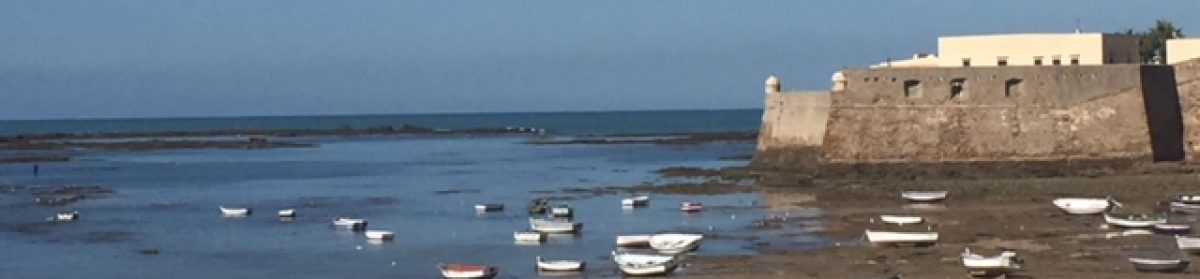
Cadiz – a sea-wind blows.

I boarded the early morning bus in Estepona, sorry to be leaving however, it was only going to be a short break from Nina and it was on the route she took from Malaga to Cadiz. It is a pity she didn’t stop off at Estepona but I suspect it was nothing more than a fishing village in 1934. On her bus ride Nina describes – at length, the beauty of the Spanish landscapes. The colours, the flowers, the hill sides. Turns out eucalypts were her in Nina’s day. She writes “Outside of Marbella to my surprise Australian eucalypts line the approach, growing very splendidly and making a most decorative avenue. Indeed, the gum-tree is an example of the prophet who lacks honour in his own country, for Australia has not made such ornamental use of it as Spain, where as time went on I was to see many more avenues and groves of eucaplyts”.  Nina saw cane-fields outside of Malaga as well but I did  not see any. Either they are long gone or the road now takes a different route.

The bus takes us both back through Algeciras, where our original journey began. We have done a big circle for Nina to save money and continue in the same direction. On reaching Algeciras, the bus driver gets out of his seat and yells something to the passengers in Spanish. Many of the passengers start to bustle about with bags, yelling in conversation to each other. Those of us with little Spanish sit and look trying to work out what is going on. I understand one word “todas”, all of you. The bus driver makes his way down the aisle of the bus, still yelling Spanish words at us. He says “commer”, food, raising pinched fingers to his mouth. Finally, with the help of my limited Spanish, I work it out for me and my non-English speaking companions. I tell them the bus takes a break here for half an hour and we are to get off. One woman asks me if she is allowed to sit on the bus during this time. I tell her that does not seem possible and to take the opportunity for a rest break and to stretch her legs. The driver seems happy we have finally get the picture and are moving off the bus.

Back on the bus, the route now turns away from the Mediterranean and we now head inland. First we must travel travel through the ugly outskirts of Algeciras. Algeciras is a port town. Its large 1960s apartment blocks are a decaying eye-sore. Once in the country again the Spanish landscape is beautiful and we have left the over-development of the Costa del Sol behind us. At Tarifa, we begin skirting the coast of the Atlantic Ocean. The coast here is known as Costa del Luz, the Coast of light. It is not difficult to understand why. It is raining yet the sun turns the ocean silver against the bruised, grey sky. The light and colour play magic scenes on the ocean, on the paddocks and on the forests. Sometimes it looks like you can see rainbows on the ground. There are paddocks with donkeys in them. Just as Nina witnessed on her travels. I see the same landscapes entering into Cadiz as Nina described. “From all this beauty of meadow and wood it was strange to come at last in the late afternoon to the low-lying salt-marshes that surround the rocky island on which stands the naval town of San Fernando. From these marshes the salt is obtained by evaporation. The whole locality is cut up into square depressions where the waster gathers and dries. It is a curious white countryside, flat except for the white houses and white pyramids of dried salt”. This area remains unchanged except I suspect the road is much wider now. The bus bumps along it, for although the road is now a modern, newish four lane highway, any road built over a marsh will bump and buckle and rise and sink with the marsh.

Entering Cadiz is on a “narrow, flat, sandy spit, after which you arrive in Cadiz through the most satisfyingly impressive entrance, driving under an ancient gateway, with old bastions six feet through crowing about it. Some of it crumbling. But they are imposing, picturesque; right for a place with the history of Cadiz. Cadiz that was well-known in King Solomon’s time, and is so ancient a site the Greeks declared Hercules to have built the first city founded there”. My bus runs along the same sandy spit with the Atlantic Ocean on your left, then the road, then the train lines and then the Bay of Cadiz to the right. I enter through the historic gate just as Nina did. I smile to myself, it is no longer crumbling but ask myself if, and how, it has changed.

I start to make my way on foot to my accommodation, Case de Caracol – the snail’s house. So called after the monchillas (shells) or backpacks. I take a wrong turn out of the bus terminal and come across two men. The young one is holding what I think is a replica gun – I hope it is a replica because it looks awfully real – behind an older man’s head. The older guy is kneeling on the ground with his hands behind his head. In careful, slow, precision movements, the older guy kneeling takes the gun from the young guy, explaining each of his slow actions. Ah, grasshopper! It is obviously a self defence/krav magna tutorial for the younger guy. I stay to watch them for a while and to pick up some free useful tips. Although I hope not to be held up at gunpoint.

Nina is in love with what is left of the ancient history of Cadiz which began in around 1,100 BC but she laments the lack of evidence of the Phoenicians . She says “except for those bastions and a few fragments of the old harbour-works, remain to draw the attention of the casual visitor”. For this she blames the English, Sir Frances Drake and English Lord Essex of “plundering the town so savagely it had to be rebuilt”. It is still a nice town with impressive buildings from the 17th – 20th centuries. It simply is just not the ancient town it could have been today. I visited the old Roman ampithetre today – or what remains of it. The theatre was only discovered during excavation in the 1980s. Nina would not have known or seen this. Yet it was something extraordinary just below the surface of Cadiz.

Nina’s experience was that the people of Cadiz “accept strangers casually, and beggars are rare”. I have found the Spanish people here a little harder to deal with and there are now beggars everywhere. It is a city that fills up during the day with three or more cruise ships in the port. It is also a haven for backpacking surfers chasing the last of the summer sun rather than tourists wanting to see and learn of it ancient history. I walk around feeling the sea breeze slip up the streets from the Atlantic so that it calls me to its fortifications along the ocean. I walk until I can no longer find shade to walk in as the sun is now high and hot. I scurry off to the cool laneways to find my way back to the old centre of town.

I visit the Cathedral, as Nina did. Although she visited when the ‘cannons’ were at their singing and there was no-one else in the Cathedral apart from two little girls. There were no priests or canons singing on my visit, the choir seats were empty except for the tourists listening in on their audio guides to the information about the 41 seats, the type of wood used, the carving and the architects. It is a fairly boring and bland Cathedral compared to most others I have seen. It is a huge, cavernous structure with what looks to be like fishing nets stretching below the vaulted ceilings and archways. I figured the fishing nets were to catch any falling bits and pieces of rock and mortar from falling on the tourists that walk around its cavern by the dozens.

Nina spent just a day in Cadiz but she wrote that she will always remember “the touch of the sea-wind blowing up a narrow street that I feel upon my cheek”. I am still unsure if I like Cadiz or not but I know one thing – I too will remember that sea-wind on my cheek.

I travelled alone in Spain

I had decided to take my own path. To travel alone in Spain. To leave Nina behind and to catch up with her again in Cadiz – but you know how short breaks go – you start to miss the other person. All you can do is think about them. What they are doing, what they would have said, how they would have reacted. I had barely been on the bus to Estepona for twenty minutes before I started to think of Nina. For most of the journey the road runs parallel to the Mediterranean coastline about five kilometres inland. It traverses a  ridge and from my vantage point high in the bus, high on the ridge, I can see the sea. I can also see what this part of Spain has become. I can see the high-rises, the urbanisations (developments), the holes left in the ground from the global financial crisis and I can see the golf-courses. Golf course after golf course, green after green – surrounded by clay-coloured modern villas where the (mainly) Brits live. I imagine what it would have been like when Nina travelled alone in Spain. There would have been farmlands dotted with small villages of white houses, narrow streets and the inevitable donkeys she came to love and wax lyrical about.

I had put Estepona on my list on the recommendation of a friend and to have a break from Nina. In searching where to stay in Estepona many of the places were out of town in the urbanisations with their pools, tennis courts and golf courses. I wanted to stay in the old town. I wanted to do my best to be true to Nina. So I found a hotel (one star) in the heart of the old town. The old town is beautiful. The white town houses of the narrow streets are full of flowers and plants. Pot plants hang off the walls and balconies, they line the streets. Each street has a unique colour for their pots, some streets have blue pots, some green, some are pink with yellow polka dots and some mix them all up – but uniformally so. All of them have a crazy riot of flowers blooming out of them.

I find my hotel in Calle Veracruz. It is as I said, one star, but I have never stayed in a more beautiful place. My room is directly off the courtyard. There is a fountain in the middle, historic old arches, painted tiles of local scenes from Estepona and further afield in Andalusia. I see the Puente Neuvo from Ronda at the wrought iron gates into the courtyard. A large bull looks down at me, watching me write from up above. I think it is a real – though long dead – bull. In fact he’s stuffed. In my room, roses are on my bed, it is spacious and so very clean. It is artistically decorated in the old style with a shower room and walk in wardrobe. All this in a one star. I don’t believe I have ever stayed in a five star hotel this good or this beautiful. This morning at breakfast, included in the price, I meet an elderly German couple. We get to taking over the communal table. They come here for five weeks every year. They used to own a house here for many, many years but now the stay here – it is like home they tell me. The have the large upstairs suite on every visit. I tell them what I am doing and what I have done. There are curious in my following a woman half way across the world, who travelled here in 1934. They are keen to hear about my experience in walking the Camino de Santiago earlier this year. The woman asks me “Did you find yourself?”. I smile and laugh and give a look to say ‘HA!’ as I shake me head. Her husband tells me about another pilgrimage, held once a year. He tells me it happens in a town near Seville called El Rocio. I get excited, I know that Nina went to the festival associated with this pilgrimage when she was in Seville. Again … I find myself thinking of Nina. I show them my book and now they are excited. We talk until breakfast is over and I head down to the beach  for a walk along the promenade.

I am happy to be in Estepona during the ‘off season’. I can only imagine what it is like in summer – and would love to experience that as well. Along the beach there are little restaurants and terraces, places to hire sun lounges and have a cerveza. Some of these are open but many are now closed until next March. There are few people on the promenade this morning but I imagine when the season is ‘on’, this place is on. There is not a lot to do in Estepona during these months. It is not warm enough to swim and the souvenir shops are few and far between. However, if you are after the resort wear then you would be overwhelmed by choice. There are no sights of historic interest, apart from the old town itself and no galleries showcasing amazing art. Even the town church is uninspiring from the outside. Apparently, the town clock is considered tourist attraction although I don’t know why. What this town lacks in things to see it makes up for in its flowers, its gardens, it fountains and the very nature of what it is – a spectacular little place. It would be a great place to get a house for a month and have friends visit. To swim in the Med and to eat the incredibly fresh and inexpensive seafood. This is a holiday town not a tourist town.

In this particular part of Spain, it is difficult to know who is Spanish and who is English. This is especially true when it comes to the women. English women are tanned to a deep brown and the Spanish women blonde their hair. In the morning, all wear active wear and in the evenings and night all dress up in tight clothing and high heels. Yesterday I stopped for lunch at glanced at two abuelas (grandmothers) who were at another table. Both would have been in their 80s and dressed very conservatively – as you would expect from an abuela. They ordered two small beers. The waiter asked if they would like a tapa with their beer. In rapid, righteous Spanish they replied “Of course, yes!” and implied ‘and you an idiot?’. It was only later that I noticed they weren’t Spanish at all as they conversed in their clipped British accents. Nina would have loved Estepona. I do!

Picasso, all saints, history and sunshine

I don’t have the patience for Picasso. Don’t misunderstand me. I like his work and he rightfully holds his place in the art world – but I get a bit bored of much of his work quite quickly. Perhaps I don’t have the right attitude or perhaps I am being deliberately obtuse when it comes to his work. I thought I would test out my theory and go to the Picasso museum in Malaga today. He was born here in Malaga but his family moved away to the north of Spain when he was about ten years old. His socialist leanings, his painting of Guernica – one of my favourite paintings – forced him into exile in France during the reign of Franco’s dictatorship. Still Malaga claims Picasso as its own.

Last night, I took in a sunset drink on a roof top. I went home early, not just to get up early, but to avoid the Halloween festivities that were happening on every street. Today is All Saints Day. In the Catholic church, it is a Holy Day of Obligation which means you must attend Mass. In Spain they take it one step further and it is a Public Holiday. Lucky for me as this means Spaniards get up even later than they would normally, so I am off to the Picasso Museum without much of a crowd. In fact, the streets are almost deserted with the exception of the odd stray cat. Apart from the permanent Picasso exhibition there is a second, temporary, exhibition ‘We are completely free’. I get the double pass to see both exhibitions. I walk around the galleries looking at Picasso until I spot a sign and a staircase going down. The sign says “Archaeological Site”. I go down the stairs. I am the only person there. The silence is beautiful. I had not realised that the ground beneath the museum preserves important evidence of Malaga’s past. Malaga is the second oldest city in Spain and one of the oldest in Europe. The Phoenicians and the Carthaginians were here well before the Romans. There are exceptional Phoenician, Roman and Moorish remains, as well as those of the Renaissance palace. In Australia, I get excited about bits and pieces that have been dug up from sites that date back to the early days of the colony. Here on display was not just the ancient bricks and stones of houses, the ancient bricks and pavers of Roman roads, or the ancient embedded earthen jars for storage of food and water but there were other fragments of Malaga’s history some dating back to the seventh century BC. I walked around the walkway taking it all in with just the sounds of my footsteps and my breath.

Once, I finish marvelling at history, I visit the temporary exhibition ‘We are completely free’. It is an exhibition of women artist and surrealism. It is an astonishing, international collection of art created by women who would have been painting around the time Nina was touring Spain. Now I am marvelling at the achievements of woman who lived in a man’s world of the 20s and 30s. Nina included.

I walk back out into the sunshine and onto the palm shaded streets. Malaga has – on average – 350 days of sunshine every year. The smell of the river, canals and drains are further proof of this fact. It is now almost midday and the Spanish people are coming out, hitting the cafes for breakfast, which will then turn into lunch before returning home in the evening and coming out again at 9:00 or 10:00 pm for dinner. I can’t manage this. I have been trying to get into and onto Spanish time but years of conditioning of the nine to five (plus) make it difficult. I head back to my room to work on the logistics for tomorrow. Tomorrow, I am taking a break from Nina. After all I am completely free and it’s good to take a break from your travel companion once and a while. My friend Jan, from the Camino, recommended I visit Estepona. It is on the way but I am cursing Nina and her reluctance to travel backwards in the same direction. She has me travelling in what is essentially the size of a big six. Starting from the inside and doing a big circle before shooting up to the north east for Madrid. I shall meet up again with Nina in Cadiz. Nina spent just one night there but I hear it is worth staying a few nights. After all, Cadiz is the oldest city in Spain.

Malaga – you surprised me but you did not disappoint.

I had zero expectations of Malaga. In fact, after the love I found in – and for Granada, my expectations were below zero. I had thought that given the amount of Brits living here it would be a built up, apartment/residential town. I think too that Nina added to my negative expectations.

Nina’s journey began on her bus ride from Granada to Malaga. By all accounts it was a wild ride down steep hair-pin curves, where goat herds and goat herders would have to scramble either down, or up, the steep mountain-side as the “great bus would round a corner suddenly”. The road, according to Nina ran “perilously close to the edge of the stony steep that fell away into the valleys – the great valleys with mall lone hills set about in them”. She laughs at a “little fat man in front of me, leaning forward, with both ands an desperate expression, to grip the back of the next sear everytime we came to a fresh corner”. My sleek, modern coach drives smoothly down the auto via – which would not have been here in 1934. I looked for signs of the old road Nina described and every now and then fancy I would catch a glimpse of it. I think of what a bus in 1934 would have looked like and I cannot conjure one up in my mind. I make a mental note to google 1934 bus when I reach Malaga. So comfortable is the new modern coach travel that now one clutches the seat in desperation but rather sleeps or looks at their phones. In no time at all, we arrive safely in Malaga having not seen one goat herd.

Nina wrote that she would “always remember Malaga, because there, for the first time in my life, I had a curse put upon me”. For the first time she was happy not to speak any other language than English – so she could not know what the curse was. I have not received a curse here – yet – and obviously hope not to. Alas, however, I find another difference between Nina and me. Nina says “Malaga’s Cathedral is thrilling outside, but not so very beautiful inside, except for its vastness and the line of round arches of its rosette-studded vaulting”. I found it to be very beautiful inside and out. Like Nina, I sat in there for quite a long time. Like Nina “there steals upon you a quietude, a serenity of mind the secret of which is almost lost nowadays”. Nina wrote that in 1934 – imagine what she would have thought of modern life in 2017!

“Malaga is surprisingly modern after Granada”, both Nina and I have found this. Nina appreciated how progressive it was and there was much less staring from the Spanish. I enjoyed Malaga as it is a much less tourist destination. One that doesn’t have a ‘tourist area’ but where locals, ex-pats and tourists all intermingle on the streets and in bars and cafes.  Nina found Malaga as one of the nosiest towns in Spain. I think all of Spain is noisy now. She would not have had to put up with the noise of motor-bikes everywhere. Surprisingly, that is all Nina had to say about Malaga. I have found Malaga to be a beautiful old town. So much of its history and its beauty has been retained, despite the revolution, despite the Civil War, despite the English and despite modern development. I arrived on Sunday afternoon and went out for a walk. Unfortunately, I walked in the wrong direction from the town and did wander into the modern suburbs, built in the 70s and 80s. This did my low expectations no great favours. On Monday morning, I walked in right direction and found the town. Before long I was in the inevitable maze of narrow laneways and streets, unsure of my direction. All of a sudden I was in a square and the Cathedral rose majestically in front of me. People sat drinking coffee and orange juice while eating toast or dipping their churroz into cups of thick Spanish chocolate.

From the outside of the cathedral you can notice it only has one corner tower. The other remains unfinished. There are several theories to this which Spanish historians argue about. One is that the Bishop of Malaga gave away the money for the second tower for America to fight against the British during the American War of Independence. Spain and Great Britain at the time, were great enemies. Another theory is the money was given by the Bishop to build a road, important for trade, over the mountains out of Malaga to connect with the rest of Spain. Of course, there are those who believe the Bishop simply kept the money for himself. Whatever the reason, the debate today is on whether they should finish the Cathedral by building the final tower or leave it has it has now been for centuries.

Even though it is autumn in Spain, the days are still hot. The afternoon sun still stings. When I walk, I follow the shade. Always the shade. It is easy to do in the narrow Spanish laneways. So build for this purpose, to keep the houses and streets cool on the hottest summer days. The maze element was to confuse any armies who thought it a good idea to attack. The narrow streets also did not make it easy for any attacking army to go through more than one or two men together. There is still an ancient Roman amphitheatre here in Malaga. However, it is less than impressive, especially after the extraordinary large one with extraordinary views out to Mt Etna, that I sat in at Palermo, Sicily. I am yet to see better than that but suspect I will not.

Granada, my love!

I must admit, I felt a little bit like Nina did on entering Granada. I had my doubts. Nina stayed two weeks here. I have stayed just one. Yet it only takes one afternoon to fall in love with Granada. Everywhere there is beauty. In the simple white houses that dot the hillsides, in the honey-orange walls of the Alhambra, in the gipsies singing and dancing and in the buskers playing traditional music in the streets and laneways. Other cities are known for being cities of love, Rome, Paris, Venice – for me it is Granada for here I have found love.

Nina wrote “If psycho-analyst were to demand your thoughts in response to the mention of Granada I think it would almost certainly be the Alhambra. But there are other things besides the Moorish palace to see there …” Nina pokes fun at the travellers that whiz about on tours, one day here, two days there. She asks herself if they would “be aware of the small, delicious things that make all the difference between travelling and globe-trotting”. She answers herself my musing on how mush they miss “the globe-totters who are too hurried to notice or remember the things that make a foreign place for every your own!”. In Nina’s time these globe-trotters would buy postcards to remember where they had been and what they had seen. Now it is the selfie stick, camera, mobile phone and go-pro to ensure you remember what a great time you had. Then again, there are those travellers who stay too long as evidenced by their dreadlocks and their dirty feet poking out of the bottom of their Vietnamese fishing pants.

I remember little things from when I walked the Camino – little things that I took no photos of. A line of caterpillars on the track or the butterflies flying in front of me like I was in a Walt Disney animation. In Granada, I will always remember the art and taking the time to go slow. I will remember sitting on the terrace and looking out over the landscape to the Alhambra. I will remember sitting in the shade of a garden on a seat – Princess Diana like – and simply staring at buildings, at fountains, at tiles, at views, at trees, and oranges and flowers. I will remember how hard it is for a single traveller to travel alone – even though it is way beyond 1934.

Nina found the “Spanish stare” disconcerting. Spanish men would stare at her being a single woman alone. I don’t get the “Spanish stare” but I do get the looks. I will walk into a restaurant or a café – alone – and the service staff will ask me “how many?”. “Uno solo” I will answer holding up one finger, they nod and find the most inconvenient table, where one can hide a solo traveller. On my tour of the Alhambara – there were 29 of us – I was the only single traveller.  On my day trip to Morocco, there was a nice equal ten of us – thanks to the British couple who brought along their 12 year old grandson. Restaurants and cafes have ‘paella min personas 2” chalked up on their black boards. Today I went to the hammam for a wash and a bathe – I was the only single there. The baths were full of couples who had come to experience something, that I believe is more pleasurable alone, together. Don’t get me wrong, I love travelling alone, I simply wish travel was more suited to those of us who do travel alone.

Frankly I roll my eyes at those that travel together. The other night I was in a café and two couples of Brits sat at the table next to me. The conversation went something like this:

Man one:  Should we just get some beers to start with?

Thin lipped wife: No, let’s just look at the menu first.

Both couples nod and agree and talk about what food to order.

Waiter (in broken English): Are yous r-r-r-ready to order now?

Thin lipped wife: Could we see your drinks menu?

Waiter: No drinks menu. We have sangria, we have vino tinto, vino blanco, cervezas, agua ….

Three of them order a beer. Thin lipped wife, who looks as if she slogs out ten ks on the treadmill at the gym every night, orders a white wine. I am certain she would have asked for ice if not too scared she would get sick of drinking the water/having ice in her drink.

Saying that, I have met some lovely couples on my travels. The other afternoon I was up on the terrace of my accommodation and a Spanish woman came up with bags and also, bags of groceries. She was attractive, thin and muscly, with some pretty good tattoos. Her bleached blond hair was fashionably cut pixie short, she had a pretty face and a smile to die for.  She could not work out how to open the door of her room.  Having been through this two days before, I explained it to her. “Muchas gracies!” She introduced herself as Monica, I told her I was ‘Genobeba’ (the Spanish pronunciation of my name). She replied “encantada”, enchanted. I did the same. She told me she could only speak a little English, I told her “Yo hablo Espanol, muy poco” (the same, just a little). Through our Spanglish, I understood that her girlfriend was arriving that night, the she was very impressed with the shared terrace and the fantastic  views and we should get together for food and wine up there.  We did the following day when I met her girlfriend, Gabriella. Gabriella is a vivacious, beautiful, intelligent Canadian from Montreal. We spent some time speaking English/Spanish with Gabriella translating when Monica or I talked too fast and we were missing the whole conversation. I asked how they had met. Both broke out into huge smiles and virtually giggled, looking intensely at each other. They had met in Spain just in the last few months. Gabriella had to go off to meet friends and travel a bit as plans and accommodations had already been made. She was supposed to go back to her job in Montreal but decided she could not. “We are in love and you must take that seriously. Yes?”. Yes, I confirmed, “es verdad”, it’s true. Both were totally shocked to find out that Australia, which they thought was a very progressive country, still did not have marriage equality. “Si, si, si. Es muy triste pero es verdad”, I replied. Monica gave me a really good tip on where to find the best tapas bars before we said our ‘hasta luegos’ – see you later. I still don’t think the tapas here are as good as they are in Burgos and Santiago, but the tip helped a lot.

Taking things slowly has shown me love. Looking around and enjoying differences. Seeing, smelling hearing. I remember in Prague Joe told me not to give money to the buskers that do nothing. The ones that stand there painted in metallic paint not moving for hours. He told me I should give to the people that do something, musicians and artists. This is what I have been doing in Granada. I stop to listen to the buskers and give them some change. I bought a poem for 60 cents from a stand. It was in Spanish and a beautiful love poem. I now have it in an envelope to give to Monica and Gabriella with all of my wishes for their love. I stopped by a gipsy boy today, not much older than my son Joe. I stopped so that he, with the use of his tarot cards, could tell me what he foresaw in my present and my upcoming future (it was good advice) and well worth the few euro donated to him. We ended up talking until the sun got too hot and he needed to find some more customers. Here in Spain, this time, I sit on my own in cathedrals and churches, not to pray but to simply sit (and try not to ponder the bad deeds of the Catholic church) but to see the beauty in the building and look at the art. I cried at flamenco for goodness sake!

Granada is a very easy city to get around. The buses are simple and everything is in walking distance – if you like walking up and down some very steep hills and stairs. The Albaicin is not so easy to get around. It is very easy to get lost in its white walled mazed passageways, where all the house are called Carmen. The Carmen houses have gardens and all their names begin with Carmen, there is Carmen Victoria, Carmen la Nina, Carmen … you get the idea. It originates from the Arabic word for vine – as the Carmen gardens provide food, shade and beauty – which equals love in Granada.

I left Granada this morning. I waited for a taxi on the corner of my street Cuesta del Chapiz and the Paseo de los Tristes. Paseo de los Triestes, is the street of sadness. Traditionally funeral processions would go along this street (sometimes with professional. paid mourners) up to the cemetery near the Alhambra. It seemed fitting to end my stay on this corner – one street where I found so much happiness in simply staying there – and the other so much sadness to be leaving.

If you do one thing in your life. If there is just one place you go in your life – go to Granada. You will never regret it.


Palaces and politics

I spent days eyeing off the Alhambra from every level. From the narrow street below. From the view of St Nicolas, from the terrace of my accommodation. I ‘eyed it off’ at all times of the day and night. I had walked beneath its shade and past it on the hop on/hop off bus/train. I went up to go in, only to see the ‘Sold Out’ sign – and again walk beneath its shade through the forest back home. From all of those levels, whatever time of day it looks like a fort. Its walls a golden orange colour in both sun light and in moon shine. The thing about the Alhambra is – that it is not a fort. It was once a great city. A city to approximately 2,000 people. Now it is a tourist attraction that caters to over 9,000 visitors a day. Little wonder the ‘Sold Out’ sign is on permanent exhibition.

Finally, I was there. Ticket in hand at 7:30 am. It was still dark. I had caught a taxi up from the main square, rather than walk up through the forest in the dark. After all, when Nina had gone up in the dark to experience a night time festival, she and her guide heard the Civil Guard shooting at people. By the time our group got through the gate it was after 8:00 am and the sun was beginning to shine. Our first stop was the Generalife – the Sultan’s summer palace. We walked through the most beautiful gardens to get there. These are not the original gardens but came much later and in the style of Versailles – except a lot smaller. There were pathways and alcoves. Pines cut into the shape of walls and archways. Coloured flowers everywhere. There were huge, old magnolia trees, it would be magnificent to see them in flower. The Generalife itself is beautiful. Totally white with carved timber ceilings, faded tiles and Moorish door ways and windows. We see rooms that are merely alcoves off the halls, open to the air to catch the summer breeze. The Sultan and his wives would have slept in these rooms during the heat of the relentless Spanish summer. The gardens with their fountains and ponds would give cool respite during the day.

We then walked into the Alhambra. Past the stone footings of old houses that villagers lived in. Nina refers to the Alhambra as an “airy, fairy palace” that has a “bijou quality, slightly irritating because of its childishness artistically. And there is bad taste too, especially in the colouring of the tiles that decorate the walls – in their really in-artistic greens and blue and browns which must have been even worse before the centuries toned down the crudeness of the colours. (And if you consider this a heresy, you must please forgive me and go and have another look for yourself!)”. Oh Nina! Later redeeming herself – in my eyes – by writing “I hardly know which is more potent at the Alhambra, the charm within its walls or the lure of looking beyond them through the fairy frames its window make – those narrow, arched windows sometimes in pairs separated by a slender and diminutive column of alabaster and bordered with a white stucco embroidery of jasmine-flowers and tiny shells and the lovely, fluent, ancient script whose rhythm seems one with the sound of the fountain’s flowing”. The script she refers to is in Arabic and translated it is “There is no conqueror but God”. Strange in a land that has been conquered and has been a conqueror.

Nina wrote that is “is possible to ‘do’ the Alhambra in an hour. I don’t think so. You would see hardly anything as there is so much to see and to feel. Like Nina, I also believe that you need time “to stand and to stare”, or as I preferred to find a seat and to stare.

Nina had her own guide in Granada who took her around and showed her the sights of the town and the Alhambra. He was a young Socialist who told her that the Spanish revolution was not far off. He told her how the people were hungry and that despite the strictest laws against the possession of firearms, every worker had a gun hidden somewhere. The intention, he told her, was “to aim at a bloodless revolution, but if that ideal were not realized the firearms would have to talk”. It was from this man Nina learned of the bitter hatred the people bore towards the Guardia Civil. I learnt of the peoples hatred for the Civil Guard many years later through Spanish friends and families. Many people here in Spain have not forgotten the Civil War. Stories of horror and atrocities are passed down through the generations. Recent television footage of the Civil Guards beating people in the streets of Barcelona, was abhorrent yet not surprising to many Spaniards. During Nina’s time, if a “man’s politics might be troublesome; he would be arrested on some trumped-up charge, and the next thing you heard was that he had been shot by the Civil Guard while attempting to escape”. Usually, the guards would tell the man, his arrest had been a mistake and he was free to go. The moment he turned to leave, they would shout after him, take aim and shoot him in the back. I had heard a story of a pregnant woman who would not reveal to the Guardia where her husband was. He was suspected of being a republican during the Civil War. As she would not tell them where he was, they poured olive oil into her throat. Her husband was indeed a republican but she honestly had no idea where he was.

I have thought about Nina’s politics as I have read through her journey. She was a trail blazer for her time. One day she was sent to report a meeting of the Senate at Melbourne. The Usher of the Black Rod spied her in the Press Gallery and sent a messenger asking her to ‘withdraw’. Apparently, a friendly pressman intervened with an explanation that she was a journalist and so ended the “unwritten law that a woman should not penetrate to the Senate Chamber”. She worked on newspapers, travelled alone as a woman, started the Argonauts Club on the ABC, which some baby-boomers may remember. I would have thought Nina to be a feminist and an education liberal. Yet again, she was a product of her times. Nina was first and foremost a citizen of the British Empire and when her young guide told her “The Government must be made to see all these things … There must be dole for the unemployed. The children must be properly fed and properly educated”, Nina was “afraid some of the things which he secretly pleased my hunger for the picturesque will be swept away if he ever gets his way in Spain”. Perhaps more of a political conservative than I had imagined.

During my tour of the Alhambra I was surprised to find something Nina did not mention in her account, the Palace of Carlos V. Carlos wanted a residence befitting an emperor. It is a large palace out of sync with the rest of the Alhambra. It is a much more modern, Renaissance building. Large stones make up the outside square shape of the building. Inside there is a courtyard yet it is round, like a bull-ring. The palace was never completed, its rooms never decorated. Carlos V and his wife, Isabella, never lived there. It is a folly. Carlos V abdicated, left Spain bankrupt and retired to live alone in a secluded monastery. I suspect Nina – unlike me – was also a monarchist.

The Gipsies (title Chapter four of She Travelled alone in Spain)

“Academically, you should not consider Granada until Cadiz, Cordoba, and Seville have been visited. But when it comes to buying a kilometric railway ticket for your travel you are forced to abandon the romantic idea of flowing from the south in the track of the Moorish invaders … train travelling there is not cheap enough to encourage going over the same ground twice”. With this, I followed Nina to Granada immediately after Ronda.

I caught the train, as Nina did, but owing to track works I was forced to take a bus for the last one hundred kilometres. Last on the bus, I got the very front seat. The landscape that wizzed by the highway was dry, typically Spanish, with orchards and olive groves. There was a large mountain here and there but as we got closer to Granada, I could see the Sierra Nevada mountain range. Sierra Nevada is the ‘snowy mountain range’ and contains the highest point of continental Spain and one of the highest on the continent. Yet, I was surprised to still see snow on the top of the ranges as we hurtled into Granada. After all, it was autumn! For the time I spent in Granada, I was always pleasantly surprised by the snow, especially when it worked as a back drop to the Alhambra.

Nina believes “Granada is not a city that delights at first glance. It presents itself as a crowded, dusty place of narrow pavement where the poor man flings his grubby-looking coat across his shoulders like a cape, with sleeves swinging so that however you compress yourself passing by you cannot prevent their brushing against you”. Some things have changed since then, the poor are not as prevalent and I never felt the need to avoid touching against people. In what has not changed, is that you cannot avoid it. The streets are some of the narrowest I have ever walked. Pedestrians share with cyclists, bikers, cars, taxis and buses. “The Carrera del Darro is so narrow that to allow a motor-car to pass along it a panniered donkey must retire up a side-street and the pedestrian must flatten himself against a house-wall”. Nina was right! I was in a taxi on my first trip along the Carrera del Darro, one of the oldest streets in Granada. It is barely wide enough for a car. As my taxi started driving down the street, I let out a breath of shock. I thought he was driving into a pedestrian mall. It was Sunday afternoon, the sun was shining and all the tourists and locals were out walking. The ride along it was so slow. The driver had his window down to ask people to move out of the way to allow the taxi through. Luckily there were no donkeys burdened with heavily laden baskets thrown into the mix. Shortly later, we had to stop behind a bus – which was actually more of a mini-van – for passengers to get off. While we waited, throngs of people of all ages, all cultures and all shapes and sized flowed around us like a human river. This was my introduction to Granada as the taxi then made its way up the steep hill to my accommodation.

I am staying on the edge the Albaicin and Sacro Monte areas. Albaicin is the old Arabic quarter and Nina informs me that Albaicin is “actually a corruption of the Arabic words meaning ‘the falconers’ quarter’”. All the white washed houses have central courtyards and gardens. Old Arabic styles which have been transformed externally into what looks like more traditionally Spanish houses. Everytime I see an open front door, I try to get a glimpse in at the tiles, the terraces and the gardens – to see if the house has a water feature or fountain. The Sacro Monte area is the traditional gipsy quarter. The gipsies lived in caves which run along the foot of a hillside covered in prickly-pear. The gipsies have lived in these caves for more than five hundred years at least. When Nina visited Guardia Civil (Civil Guards) guarded the end of the street, visitors were warned against going their without a guide or a police escort. Nina visited and saw no one there “with half the menace of some of the Civil Guards”. The only guard on duty now is on the corner across the road from my room, is a statue dedicated to the last king of the gipsies.

Nina was mixed in her descriptions of gipsies. I think she secretly envied their exotic lifestyle, but her good Empirical heart would not let her admit to this.  I think once she got over the “swarms of children with poor savage manners; dust and dirt; rags and papers; high, mouldering houses with washing flapping from the balconies; and then you come to a dirtier, nosier, narrower street, and you are in the gipsy quarter of the Albaicin, the Camino del Sacro Monte”. The people themselves she says “some are really plain, being flat-nosed and thick-lipped. Not all of tem are dark-haired. But every one has dazzling white teeth. And there springs from the least charming such an abundance of vitality that the air is wicked with it”.

Nina went into the Sacro Monte to see a flamenco show. She describes the dancing vividly and how she got caught up in the passion of the flamenco. She describes the dusty floors of the gipsy caves and the dancers stirring up all the dust. She is enthralled but slightly deflated when she is told at the cost of the excursion will be “thirty pesetas for the dancing, ten pesetas for the wine”. I smile and think of what she would make of £26 up front which includes one bebido (drink).

Last night, I crossed the street and walked into Sacro Monte to see a flamenco show. The caves are now shop fronts and houses from the outside but inside, they are like houses I have seen in White Cliffs, NSW. Dug out, rounded edges, painted all white with a nice cool temperature inside. The floors are no longer dust, but the dancers perform on the floor not a stage. A sprung piece of timber allows for the tap and click clack of their dancing shoes to ring through the amazing acoustics of the cave.

The guitarist began to strum, the singer, let out a lament. A young girl of about 16-17 rose to her feet and danced the dance of a bull. She was youth. Impetuous, fearless, strong, the world was before her. She danced. She was extraordinary. The rose in her hair and the Spanish comb were flung from her hair in the vigour of youth. The next woman up was a woman in her thirties, her dress of silver included an apron tied around her waist. She was wife, she was mother – she still had it. Yet no flower was in her hair. She danced with temper, a controlled, boiling below the surface frustration and life, of its ups and downs. No one could argue with her. The final woman was older. Much older. Her legs and hips were stiff, certainly not with the same vigour. The flower in her hair did not move. Her body once willowy would not allow her the movement she could once create – but her hands and her fingers … they knew the way. She could still play those castanets and have every eye in the room was upon her. I watched, and tears slid slowly down my face. This was the story of being a woman. People have often said to me that I must have some gipsy in me – the way I was moved by the dance last night certainly had me thinking. If only the Dutch tour group in the room would stop talking and laughing. Flamenco is serious business. The women told our stories of hope, of our own entrapment – of desperation and of acceptance at our price. We must dance our way through our lives – but it is our dance and our lives.

The next part of the show was more about the bucks and the men. The first young guy strutted on stage as if he owned it – and he did. He was tall, he was handsome, he was young – and my God he could move. Even in that skin tight outfit. Next were two more women. The first a blonde dressed all in black.  A dance of provocation. I figured she must have been a mistress. This one also had not flower, but rather a showy clip that pulled part of her hair up. She was followed by a dancer in a gold dress – the well heeled, the fortunate, the wife. She had a sprig of flowers that did not move, despite all the dancing to keep her man happy so he would not run off with the other. I was making this story up in my head as it went along. Who would be chosen? Neither, as after that came another male who danced up a storm and reminded me why we love men (for those of us that do). Afterwards, I sat outside chatting to the owner in English and Spanish. He told me my Spanish was very good and was impressed I was from “muy lejos”, very far, Australia. He asked me to stay for the next show – for gratis – “without the tourists”, he said to me. I did, and again, tears fell from my eyes, watching the dancers. I spoke to the oldest woman at the end. Very proudly she told me the youngest dancer was just 13.

I walked the short distance home, stopping at the statue of the gipsy king. I  smiled up at him and am glad that the gipsies remain here in Granada.

Dog of a day

Today’s blog was going to be about Nina and me, but after the day I have had, it is more about me. As usual. Truth be known, I haven’t read the whole of She Travelled Alone in Spain as yet. I am reading it as I go. People have exclaimed “you’re mad!” – and that may be the case, yet Nina self-proclaimed herself as mad by travelling alone through Spain in 1934.

I have been reading Nina’s account of Granada, the gypsies, the Alhambra, the Spanish people, and the politics of the day. Comparing what was then to what is now. I have been making notes and underlining and making asterisk notes in my copy for this very purpose. Nina devotes a whole chapter to the Alhambra. I have been eyeing off the Alhambra since I got here. I have seen it through all times of the days. Sunset from the church of St Nicholas is extremely beautiful, made even more so by the still snow-dusted mountains of the Sierra Nevada. I have walked in the shade of its walls through the forest back down to the town. Until today, I have not gone inside its walls. Actually, I still haven’t.

I decided a Tuesday was the best to visit, slow tourist day and all that …. I was going to get up early and be one of the first at its gates. I woke, looked at my clock, it was 8:53 am – still plenty of time. By the time I breakfast, shower, read facebook and the local Australian and Spanish news it is half ten before I leave my room.

Yesterday, I bought a two day pass on the hop-on/hop-off train. It really is just a tractor with a fancy cover and a couple of cabooses behind. I walk down to the stop nearest to me, fearing another encounter with the ticket seller from yesterday, let’s just call her Bitchy McBitchface. Flash back to yesterday – I get to the hop-on/hop-off train station just as the train pulls in. The line for the train is long but no one at the ticket office. I think ‘ok’ as the ticket seller a.k.a Bitchy McBitchface walks off to load and off load tourists on and off the train. I wait patiently, smiling and happy in the Granada sun. The train takes off and the ticket seller, Bitchy McBitchaface comes strolling back with seven tourists in tow and tells me they are in front of me. I smile politely – but with clenched jaw and step back.  The seven tourists, phaff about arguing about how many of them they are, how much it costs, who is going to pay … and here was me, waiting, one person with correct money in hand. Finally all their dilemmas were solved and I was told to come back to the front. I politely pointed out, that I was waiting and she should not have done that … needless to say, the customer is not always right, and a slight argument ensued. I got my ticket but my revenge awaits in a TripAdvisor review.

Back to this morning, I hop on the train without drama. The train drives up and down the narrow streets as tourists lea for their lives out of the oncoming train, taxis, cars and bikes. Finally, it is now after 11:00am and I reach the Alhambra. I get out of the train and the staffer in charge of stuffing the cars today, is Bitch McBitchface – who has the hide to smile and say hello. I nod and walk up to the ticket office. SOLD OUT – in English and Spanish. There is a line to ask the man behind the red rope questions about tickets. I wait patiently in line. My turn comes, and a queue jumper is before me asking a question at my turn. Well, we Australians hate queue jumpers, I told her go back and wait, I am next in line. I asked the man if I could buy a ticket for tomorrow, he tells me that I have to get on-line at midnight and buy one. He says “make sure you do, as they are all sold in thirty minutes”. I leave and go back to the hop-on/hop-off train line. I get out my ticket to show Bitchy McBitchface, who smiles and says “yes, I remember you from yesterday. You must wait until all of these people in front of you have boarded”. I want to scream ‘I AM NOT THE QUEUE JUMPER HERE!” I smile and wait.

When we arrive back at the bottom of the hill I start to walk home, a small laneway catches my eye. I walk up and suddenly am at a grand old Grenadian home which appears to be some type of museum. I wander in, merely to catch a glimpse of its typical courtyard. Tiles, a fountain, an upstairs veranda, shuttered French doors, plants … gorgeous stuff. An elderly lady calls to me and wants to know if I want to see the museum just three Euros. I nod my head, she asks if I speak Spanish, a little I say, “I speak  English, I am Australian”.  She shows me into a room full of reasonably good contemporary modern paintings of Granada, turns on the light and closes the door behind me. I look and love. Then a huge sculpture at the end of the room captures my eye. It is life sized. There is a Christian holding a sick/wounded person and surrounded by men from each of the continents, there is an Asian, an Arab, a native American and an African. I am thinking ‘w.t.f. what is this thing I am in?’. I exit the room and she shows me into another. Again turning on the light and closing the door behind me. This room is full of religious artefacts, gold, silver, icons, everything I used to see in church growing up – only bigger, better, more bling. As I am about to leave, thinking I have seen everything, the elderly woman rushes into the room, grabs me by the hand and takes me outside. She points to three people, waiting at the bottom of the stairs, “English tour”, she says as she lets go of my hand and punches me in the back towards them. So now, with an American couple, who seem to know a lot about history and art as I find out during the tour, we have our own guide and are taken through one of the most amazing tours I have ever been on.

We are in the Casa Pissa, a home owned by a wealthy Andalusian family, who were patrons of St John of God. The saint actually died in this house and we are shown where he died. The house is a devotion to St John of God, and I have never seen such (and I will use a word from Nina here) a ‘hodge-podge’ of art and artefacts from all over the world as I saw in this amazing house. Even a shrunken head. Yep, even a shrunken head. The ivory, the art, the silver, the gold, oh – and two boomerangs from Australia. If you are ever in  Granada – put this on your list.

After such an amazing visit what else was there to do? Laundry. I needed to wash both the pairs of pants I brought over with me as well as my other clothes, so putting on my pyjama pants off I went. Across town with my bag of dirty laundry on the town bus in my pyjama pants.  Here is a word of advice if visiting Granada, avoid the hop-on/hop-off train/bus and take the town buses they go everywhere for a tenth of the price and the bus drivers are just as helpful. You meet locals too, who are happy to talk to you and help you out. Spanish laundromats are great. Usually there is someone in there to help, be it a paid worker or another washer. Today there was no one. As a consequence, I washed my clothes in the washing-machine reserved for washing the clothes and linen of animals. Dogs and cats, or as the Spanish say ‘Mascotes’ …. I did live in Mascot. I noticed only seconds after I pressed the on button – there was no stopping it.  Forty minutes till the end, the first five running around the laundromat crying “shit. Shit shit.”, another two trying to be Spanish and running around the laundromat crying even louder “oye, oye, oye!” before deciding the best thing to do, would be to go and have a drink. I found a bar sat down, the waiter came over – and it was a patisserie. No drink to be had. An Italian coffee later which consisted of coffee, ice-cream, whipped cream – and Frangelico – hey! – it was ok.  I went back and waited for my dog-washing to be over before putting it through another ‘human’ wash before a dry. All of which made me late, for the next thing I had planned on my Nina itinerary. A flamenco show. Well that will just have to wait until tomorrow night.

I did find a way out of the midnight web visit to book a ticket to the Alhambra. I booked through a tour group on line. First up at 8:00am tomorrow.  After all, Nina had a guide – which you will read about when she visited the Alhambra.

Interesting fact, the word Granada, means pomegranate, one of my very favourite fruits. Great for breakfast in yogurt. A pomegranate is a labour of love, you have to learn how to cut, to get to the sweet succulent inners of a pomegranate, to extract those ripe red seeds. Granada is just like that.


Food and the brown paper bag

There is one thing that I have found that I simply cannot agree with Nina on. Spanish food. Nina seems to loathe it. Perhaps it is because Nina travelled during such impoverished times for the people of Spain. Nina was travelling through Spain at the end of the Great Depression and in the lead up to the outbreak of the Spanish Civil War.  Perhaps it was that she was travelling before the proliferation of cafes and restaurants that modern living demands. It may simply be that Spanish food has improved over the past 80 years – or all of these reasons. Poor Nina , she described Spanish cooking as “To fry, to stew to shreds, to serve in tomato sauce, to flavour with a little garlic, and to drown in oil, are the principles of Spanish cooking”. She goes on to say that cocido madrileno – a particular favourite of mine – is a hodge-podge of boiled meats; bacon fat; cabbage; small, round, white, floury lentils and a potato or two. I know cocido as a one-pot slow cooked meal that gives you an entrée and a main and leaves you sitting on a comfy couch for an hour or so after.

Paella fares slightly better as Nina proclaims Arroz a la Valencia as a ‘good dish” and Spanish omelette (tortilla) as “unusual … Omelette with junks of yesterday’s potatoes in its pouch!” I have loved Spanish food from the moment I first tasted it as a nineteen year old. One of my favourite things in Spain is to wander about at ‘happy hour’ between 7:00pm and 9:00pm and have a little drink at a few bars. Most bars will give you a free tapa, to try. Some are amazing, some are just olives or mixed nuts. This is a chance to read the menu, view the tapas on display and see who is eating there. Tourists or locals? Nina, however, did not have such luxury, she would usually eat in the hotel where she was staying. If catching a train, without a dining car, the hotel would pack a lunch. I found this out by reading her account of food on May Day. The Spanish did then and still do observe the workers holiday. In 1934 when Nina was in Granada, the hotel announced it would breakfast coffee would be taken in the guests rooms between 7:00 am and 9:00 am. The other two meals would be delivered by the Chamber maid and should be eaten by guests in their rooms. Nothing hot would be obtainable until 2 May. Lunch and dinner would be delivered in a paper bag.

“At a quarter to one the chambermaid reappeared triumphantly with one of those brown-paper bags, bearing the hotel’s name in large letters, that you take when you have to travel by a train which has no restaurant car. She had no sooner gone that I must pounce upon the bag out of sheer

2 unbuttered rolls. 2 hard-boilled eggs. 4 pieces of cold fried fish (also suspect). A large cold meat fritter. A slab of cold omelette with junks of potato in it. A chocolate éclair. A custard horn. 2 oranges. 2 bananas.

“One glance at the fish and the sausage and back they went into the bag!

“Have you ever tried to eat cold omelette with yesterday’s cold potatoes lurking in lumps in its inside? One bite, and it joined the fish and the sausage!

“The meat fritter was not so bad. I had that for lunch with a dry roll, saving the eggs and other roll for the evening meal. But I no longer felt festive – not until I had taken the toothpicks and fixed them as horns on the forehead of the bright-yellow custard thing and made it walk into the bag after the fish, the sausage, and the potato omelette.”

Again, poor Nina! Perhaps a victim of her time.

Today, there are still some problems with Spanish food. I have heard many people complain about the lack of vegetables served with Spanish meals. It is true that the ‘side’ with most dishes in Spain is chips. You certainly don’t get meat and three veg when you order a full meal. Tapas can be worked around but most bars will have it own speciality when it comes to tapas. I met a couple from Melbourne last night in a restaurant with really good food, who lamented this to me that the food was great, but no vegetables. The secret, I told them, is to start with a salad first.

My personal tip, if you want to eat really good food in Spain – eat where the bullfighters eat.


Wandering about in Ronda

On the afternoon of my arrival, I did what Nina did. I walked around the streets exploring. Through the narrow passageways and laneways of the cobblestoned streets of the old town. I looked at the incredible  breath-taking rural views of the Gorgo de Tajo and the rural landscapes out past the gorge. With hundreds of other tourists, I crossed the Puente Nuevo, the new bridge. Puente Nuevo was started in 1759 and took almost 35 years to build. It spans the 120 metre deep chasm of the gorge created by the River Guadalevin.

Then I visited some of the old houses and palacios – the Casa Don Bosco, house of St John Bosco, with beautiful gardens and stunning views. You can only visit two rooms of the house which are more like religious shrines than liveable rooms. I went to the hanging gardens and walked around as the tourists started to thin out. Most tourists that visit Ronda are day tourists, bussed in by luxury coach from Granada, Gibraltar, Sevilla and Cordoba. They get off the coach, walk over the bridge several times, take photos with their selfie sticks and walk through the old town before following the flag, or the upheld umbrella to the designated restaurant for lunch. By twilight they have gone. This is when Nina went out walking in the rain.  I look up at the sky, large, bruised clouds threatened rain but it did not happen. I was left high and dry on my last walk over the bridge for the evening.

Nina, stayed somewhere near the gorge in a room that contained a bed, a basin and a rocking chair which she loved. She could hear the rush of the river as it pelted its way through the gorge. The river is a mere trickle at the moment and I do not get the spray as I hand my head over the bridge looking at the gorge below.

The next day, I visit Casa del Rey Moro which Nina tells me “nearly 900 years ago dwelt a Moorish chieftain with a bizarre taste in drinking cups. He had the skulls of his enemies set with jewels and fashioned into goblets”. When Nina visited the house was owned by a Duchess who had the place “skilfully restored”. It must have fallen into ruin since Nina visited, perhaps during the Spanish Civil war as it is again under restoration and I could not visit the house. I could visit the gardens where peacocks and the chicks wander around avoiding the stray cats and kittens. Although it may be the other way around.

I visit the bullring, one of the oldest in Spain built in 1784. It is beautiful. Bull-fighter aficionado and writer, Ernest Hemingway also visited Ronda. In his book, For Whom the Bell Tolls, Hemingway describes the execution of Nationalist supporters being thrown from the cliffs, this was based on killings that took place from the cliffs of Ronda. He also described Ronda as one of the most romantic cities in the world and it must be for a blokey bloke like Ernest to describe it as such.

The following morning I walk down the gorge to a place that is illustrated in Nina’s book. I want a photo of the same location. Walking down the path takes me back to my Camino days and I curse leaving my sticks back in Australia and giving my boots to a homeless person in Paris. My toes were so black and sore at the time I never wanted to put my feet in them again. They would have been welcomed on this walk down. The steps start off ok but soon disintegrate into goat tracks and river beds. I get to the spot about three quarters of the way down, take a photo and contemplate walking to the very bottom. The path by now is pretty bad so I decide to go back up. My calves burn and my knees ache.

On my return to Australia, I had told people that I had no problem walking the Camino de Santiago, with my knees. “They were fine”, I would proclaim. Not so. As I lay in bed that night I remembered how they would ache at night. Something I had wiped from my memory. Two voltarian and an extra strength Spanish Panadol would dull the pain at night and prior to walking each day. How could I have forgotten this?

By this morning, my knees felt better, so off I went to walk the city walls and ramparts, built by the Moors. I walked up steep, high steps – about knee high – and only slightly wider than me. No hand rails, no safety nets. I am not great with high places at the best of times, so I clung to the wall like a huge crab. Once up, I walked the lengths of the bits left. Stopping to enjoy the view and look at the openings were soldiers protected the city from any advancing army. I walked back into the town.

When Nina travelled in 1934, Spain was in a very sad state. She describes the begging children, in every town, in every street.  They call to her “Mon-ee! Mon-ee” and describes show they twiddle their fingers in “approved Spanish fashion”.  She goes on to say “For the impertinent insistence of begging children, the revolting methods of grown-up beggars, and the numbers of the importunate the poor are always with us”. To date, I have not seen too many beggars, the odd older man asking for some money to eat or others silently standing on a street corner with a cup or cupped hands. Last night I was accosted by children after money. However,  were in school uniforms and carried what looked to be official donation buckets, and they were collecting donations for their Catholic school. If a person donated they were given a sticker, to ensure they were not asked again my their classmates further down the square.

This morning I visited the church of Santa Maria la Mayor. When Nina was searching to visit this church she first accidentally went to the church of Santa Cecilia. In this church she was outraged by the Cathedral’s guidebook standing “in the same glass case as Alonso Cano’s exquisite ivory Crucifixion”. I wonder what she would have made of the Tapas recipe books on sale at the church of Santa Maria la Mayor, along with all the other souvenirs. Nina went to Santa Maria because “for a peseta and a half you are allowed to gaze upon an arched doorway and the capitals of two pillars ornamented with Arabic designs”, all that remains of a mosque the Moors built over a Visigoth temple. Nina was not too impressed, and neither was I. Now four and a half euros to enter, the door is mainly covered and it is only if you look carefully you can see the very top of it behind glass. The entry fee allows you to go up the stone spiral staircase to the bell tower, once the minarete of the mosque. I started up but my knees were complaining and my fear of heights not happy. So I stopped on the first level. Nina had walked to the top with her guide. When they reached the top her guide ‘bade’ her to “lean over and look down. There below, so that I looked clear down the core of it, hung the stone railing, like the skin of a neatly peeled apple”. I looked up and could see exactly what Nina was saying.

Next on my list, in following Nina, was to be a mule ride to see the sights of Ronda outside the township. I could not find a tour offering mule or a donkey sight-seeing tours. I could take one by jeep but it was fully booked and the dune buggies were just way too expensive. I think the noise of dune buggies would not have suited Nina’s sensibilities or mine so chose not to do it this way.  I could do a taxi but that just seemed too modern. After thinking it through, I decided not to do anything. Nina’s tour consisted of her guide waving his hand towards some particularly beautiful hillside crying, “Look over theah!” and then add, “’Sluvly, isen it”. He would then tell Nina how English women adored Spanish men.

“They come ovah heah because the lov Spanish men. They lov them! … you will see how good-lookeeng the Spanish men can be. I will tell you! Theah was a lady, an English lady; not middle-class – or no! She belonged to the high-life, the aristocracy … and she came here to Ronda and stayed at the Hotel C_____. And she fell in lov with one of the mozos – one of the waiters, you understand? She was mad about heem.”

Nina’s guide tells her that the English lady invited the waiter into her room one morning when no one was about.  Nina asks him if the waiter went in, he replied “Why would he not? He was not a cold Englishman! He was Spanish, and very good lookeeng!” Throughout Nina’s trip she hears stories of this kind, sometimes the woman would be American, sometimes English. They didn’t go to Spain for the art or architecture but for a “romantic adventure with a Spaniard; the Spanish men, of course, being noted for their good looks and their irresistible manner of making love!” I suspect Nina thinks the Spanish men are full of themselves.

I don’t know how long Nina spent in Ronda but three days are enough for me. Tomorrow Nina and I travel to Granada.